Why Your Child Gets Hyper When They're Tired (And What to Do About It)
Adults get sluggish when we're tired. Children do the opposite. The mechanism is cortisol, and once you see it, every bedtime battle makes sense.
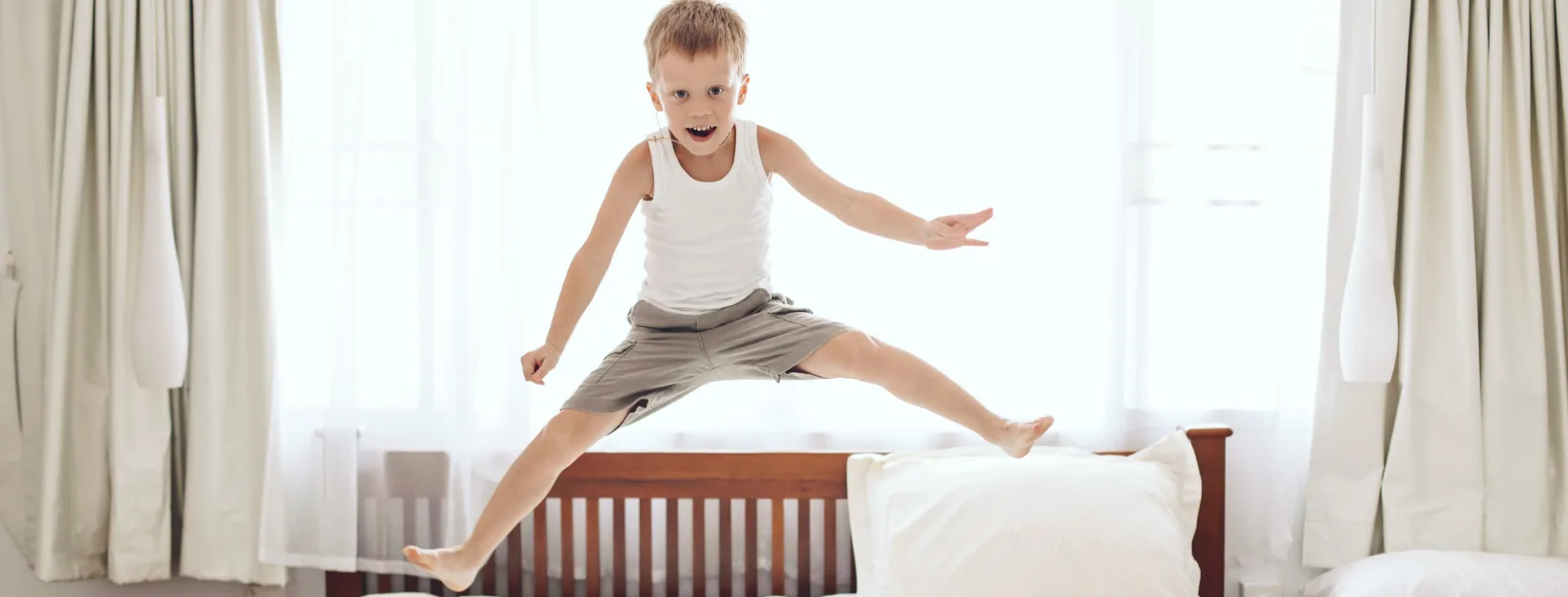
Your four-year-old has been awake since 6:30 AM. It's now 7:45 PM, which is 45 minutes past their reasonable bedtime. They are, at this moment, running laps of the living room at a speed that would shame most cardio athletes, giggling hysterically, and refusing — screamingly refusing — to put on pajamas.
The logical adult in you is thinking: if they were really tired, they'd fall asleep.
The physiological reality is: they are so tired their body has activated an emergency alertness system to keep them upright, and that system is what you're watching careen around the living room.
When a child passes the point of ideal sleep onset, their brain releases cortisol and adrenaline to compensate for depleted reserves. These are stress hormones. They produce: increased heart rate, hypervigilance, emotional volatility, and the specific wired-not-tired phenotype that every parent of a young child has seen and misdiagnosed as "they just aren't tired yet." (1)
They are not not-tired. They are past tired, and their body has opened the emergency hormone valve. And every minute you wait thinking they'll "settle down on their own" is a minute that hormone is becoming more entrenched — making sleep onset harder, sleep quality worse, and tomorrow morning's wake more miserable.
This is the single most counterintuitive fact in pediatric sleep, and understanding it changes everything about how bedtime works.
The Cortisol Curve You're Fighting
A child's natural sleep-wake rhythm isn't linear. It doesn't slowly ramp down over the course of the day toward a gentle sleep onset. It has a specific architecture, and missing the window has physiological consequences.
Roughly:
- Through the day, the wake-promoting system (cortisol peaks in morning, adenosine builds) supports alertness.
- As evening approaches, melatonin starts to rise (dim-light melatonin onset, or DLMO), creating a sleep window — a "sleep gate" of 30–60 minutes during which falling asleep is easiest.
- If the child makes it into bed, with low light exposure and a calm environment, sleep onset is fast and efficient.
- If the child misses that window — because of stimulating activity, screens, late dinner, or simply not being in bed yet — cortisol rises as a compensatory alertness signal. Melatonin production is suppressed. Adrenaline fires. The child is now physiologically harder to get to sleep than they were 45 minutes earlier.
This is why the classic parental strategy of "keep them up later so they'll sleep better" almost always backfires in young children. Later bedtime → cortisol surge → harder sleep onset → shorter sleep → earlier morning waking (counterintuitive but consistent). (2)
And it's why the "hyper" phenotype and the "can't fall asleep" problem are two observations of the same physiological event.
Why Kids Do This and Adults Don't
Adults have a fully developed prefrontal cortex and a more stable HPA (hypothalamic-pituitary-adrenal) axis. When we're tired, our inhibitory systems remain roughly online, and the feedback is "slow down, rest."
Young children have an immature prefrontal cortex (still wiring into the mid-20s) and a more reactive HPA axis. Their compensation for sleep pressure runs hotter, faster, and with less top-down inhibition. The same cortisol surge that might feel like "I should power through this meeting" in an adult presents as "I will now jump off the couch repeatedly while shrieking" in a toddler.
This is not a behavioral choice. It's not defiance. It's a developing nervous system using the only tool it has to stay online past its design threshold. Punishing the behavior is like punishing a car for smoking when the oil is low — you're addressing the wrong layer of the system.
At Avaneuro, the toddler and school-age sleep modules walk through the exact pre-sleep-gate protocol that prevents cortisol-driven overtiredness before it starts. Because once the surge has happened, you are no longer in a normal bedtime — you're in a recovery operation.
The Myths That Are Costing You
Myth #1: "If we keep them up later, they'll sleep in tomorrow."
They will not. This is one of the most replicated counterintuitive findings in pediatric sleep: overtired children wake earlier, not later. (2)
The cortisol surge that made bedtime difficult also makes sleep lighter and fragmented, and the early-morning cortisol rise (which everyone has — it's the biological wake signal) is amplified. The kid who went to bed 45 minutes late wakes 30 minutes early, tired, and more likely to be overtired again tonight. The spiral accelerates.
The counterintuitive fix, when a young child is chronically overtired, is often to move bedtime earlier, not later. 15 or 30 minutes earlier catches them before the cortisol valve opens. Sleep onset is faster, sleep is deeper, morning wake is later.
Myth #2: "They're wired, so they must need to burn off more energy before bed."
No. More stimulation right before bed makes the problem worse.
Vigorous physical activity, roughhousing, screens, exciting storylines, caffeine-adjacent snacks (chocolate), bright overhead lights — all of these drive the arousal system in the exact direction you're trying to go against. The "just run them until they drop" approach is mechanistically confused.
What actually works in the 60–90 minutes before bed: dim lights, calm voices, warm bath, books, predictable sequence. The body's parasympathetic nervous system needs time to take over. You can't shortcut it with more stimulation.
Vigorous activity earlier in the day — ideally in the morning and afternoon, with outdoor time — is the other half of the equation. Kids who have had substantial movement and outdoor light during the day have a better-calibrated circadian rhythm and a cleaner wind-down.
Myth #3: "Yawning means they're ready for bed."
Yawning is late. By the time you see yawning, eye-rubbing, or zoning out, the sleep window has been open for a while and is starting to close.
The early sleep cues — the ones you actually want to catch — are subtler: slowing down, getting quieter, losing interest in high-energy play, wanting to be held, starting to look a little spacey. This is when you move toward bed, not when you check the clock and think "we have 45 more minutes."
Track your child for a few days. Note the earliest tired cues. That's your target bedtime window, not the clock time on a sleep chart.
Myth #4: "Bedtime battles mean they're being defiant."
Sometimes. Often, they're the presentation of an already-missed sleep window.
A well-rested child approached at the right time in a calm environment goes to bed with minimal drama. A cortisol-surged child cannot cooperate with a bedtime routine even when they want to. The behavior looks like defiance, but the physiology is more like panic — an overclocked nervous system that can't downshift.
Before you escalate a bedtime battle, check: are we 30+ minutes past when we should have started this routine? If yes, the "battle" is a symptom of the timing, not the child's character.
The Numbers That Matter
| What's happening | The data | Source |
|---|---|---|
| Compensatory cortisol in overtired children | Elevated evening cortisol is measurable and predicts difficult sleep onset | (1) |
| Sleep onset difficulty with later bedtime | Overtired children take longer to fall asleep and wake earlier | (2) |
| Screens before bed | Suppress melatonin, delay sleep onset, reduce total sleep | (3) |
| Bedroom screens and sleep loss | Children with bedroom screens sleep ~30 min less per night | (3) |
| Morning outdoor light and circadian alignment | Outdoor light is 50–500x brighter than indoor, strongest zeitgeber | (4) |
| AAP recommended sleep for 3–5 year olds | 10–13 hours (including naps) | (5) |
| Percentage of U.S. school-age kids meeting minimum sleep | Roughly 20% | (5) |
Wait, Really? Morning Light Fixes Bedtime
This one is wild and almost nobody knows it.
The strongest input to your child's circadian clock is not darkness at night. It's light in the morning. (4)
Outdoor light, even on a cloudy day, is 50–500 times brighter than indoor lighting. That bright light hitting the retina within the first 30–60 minutes of waking sets the circadian clock, triggers the morning cortisol rise on schedule, and causes melatonin to be released on time that evening — roughly 14–16 hours later.
Kids who get morning outdoor exposure have a well-anchored rhythm. Kids who wake indoors, eat indoors, ride to school indoors, and don't see bright outdoor light until afternoon have a drifting circadian clock that makes bedtime harder every day.
A 10-minute walk outside after breakfast, or breakfast on the porch if that's feasible, is one of the highest-leverage interventions in the entire sleep playbook. And it's free. The Avaneuro Circadian Chronobiology module has the full protocol on light-timing for every age.
What Actually Works
1. Move bedtime earlier, not later. If your child is overtired, try 15–30 minutes earlier for a week. Counterintuitive, but it works. Catch them before the cortisol valve opens.
2. Watch for early tired cues, not yawning. Start the bedtime routine when you see the subtle cues — slowing down, wanting to be held, getting quieter. By the time they're yawning, you've missed the window.
3. Calm environment for 60–90 minutes before bed. Dim the lights. Drop voices. No screens. No roughhousing. Predictable routine. The nervous system needs time to shift.
4. Screens off well before bed. 60+ minutes for most ages, longer for older kids. Not Night Shift. Off. The effect is not only blue light — it's content arousal and sleep displacement. (3)
5. Morning outdoor light. 10+ minutes of outdoor exposure within the first hour of waking. The strongest circadian anchor available. (4)
6. Vigorous daytime activity. Movement and outdoor time during the day, not the evening. Kids who move during the day sleep better at night.
7. Know the actual sleep needs. Infants 4–12 months: 12–16 hours. Toddlers 1–2: 11–14. Preschool 3–5: 10–13. School-age 6–12: 9–12. Teens 13–18: 8–10. Only about 20% of school-age U.S. children meet the minimum. (5)
8. Protect the bedroom as a sleep space. No screens. Cool, dark, quiet. No work/homework in bed. The brain associates the space with the activity, and you want the association to be sleep.
The Bottom Line
Your child's "wiredness" at the end of the day is not evidence that they're not tired. It is evidence that they are so tired their body has deployed the emergency alertness system. Every minute you wait thinking they'll settle is a minute that system is becoming more entrenched.
The fix is not more patience or more stimulation. The fix is catching them earlier, calming the environment, protecting morning light exposure, and trusting that the counterintuitive moves — earlier bedtime, less pre-bed activity, no screens — are the ones that actually work.
At Avaneuro, the three sleep modules (infant, toddler, school-age) exist because age-appropriate sleep strategy is specific and the common advice you hear is often wrong at the mechanism level. A well-slept child is a different child. The family is a different family. And most of what gets diagnosed as behavioral problems in young children is, at the physiology level, a sleep debt that compounded and finally surfaced as something adults noticed.
Get ahead of the cortisol surge. The living-room sprints are not a sign of extra energy. They're a sign the system is burning through its reserves trying to stay online.
Go deeper: This article builds on Avaneuro's Sleep Mastery: Toddler & Preschool module — the full protocols, tools, and cited evidence base.
Related reading
- What Happens Inside Your Child's Brain When They Don't Sleep Enough
- Blue Light, Melatonin, and Your Child's Circadian Rhythm: A Parent's Guide
- Your Child Doesn't Have ADHD. They Have a Sleep Problem.
References
- Gruber, R., et al. (2012). Impact of Sleep Extension and Restriction on Children's Emotional Lability and Impulsivity. Pediatrics, 130(5), e1155–e1161. https://pubmed.ncbi.nlm.nih.gov/23071214/
- Mindell, J.A. & Owens, J.A. (2015). A Clinical Guide to Pediatric Sleep: Diagnosis and Management of Sleep Problems (3rd ed.). Wolters Kluwer. https://pubmed.ncbi.nlm.nih.gov/24931060/
- Hale, L. & Guan, S. (2015). Screen Time and Sleep Among School-Aged Children and Adolescents: A Systematic Literature Review. Sleep Medicine Reviews, 21, 50–58. https://doi.org/10.1016/j.smrv.2014.07.007
- Rivkees, S.A. (2003). Developing Circadian Rhythmicity in Infants. Pediatrics, 112(2), 373–381. https://pubmed.ncbi.nlm.nih.gov/12897290/
- Paruthi, S., et al. (2016). Recommended Amount of Sleep for Pediatric Populations: A Consensus Statement of the American Academy of Sleep Medicine. Journal of Clinical Sleep Medicine, 12(6), 785–786. https://pubmed.ncbi.nlm.nih.gov/27707447/