
Music Training Changes a Child's Brain. Literally.
Learning an instrument isn't just "a nice activity." Musical training produces measurable changes in brain structure and function — including in regions involved in language, attention, and executive function.
The research on music and the developing brain is one of the cleaner examples of "it actually does what people claim." Learning to play an instrument, when sustained over years, produces:
- Increased gray matter in motor, auditory, and visual-spatial brain regions (1)
- Enhanced white matter connectivity between hemispheres (the corpus callosum in musicians is larger than in non-musicians, especially those who started young)
- Better phonemic awareness — the ability to distinguish and manipulate the individual sounds in spoken language — which supports reading development (2)
- Improved executive function — attention, working memory, inhibitory control — with effects that extend beyond music to academic performance
- Enhanced auditory processing in noisy environments — musicians are better at hearing speech against background noise, an attention-dependent skill
- Long-term cognitive benefits in older adults who were musicians earlier in life
These findings come from both cross-sectional research (comparing musicians to non-musicians) and longitudinal research (tracking children who take up music training vs. matched controls). The longitudinal studies are particularly important because they establish that the effect is causal — music training is producing the brain changes, not pre-existing brain differences producing interest in music. (3)
For parents, the practical implication is: music training, especially when started early and sustained for multiple years, is one of the best-established enrichments for the developing brain. It's not just culturally valuable. It's neurologically shaping.
What Music Training Actually Does
Playing an instrument is an extraordinarily complex neural task. In a given moment of playing, the brain is simultaneously:
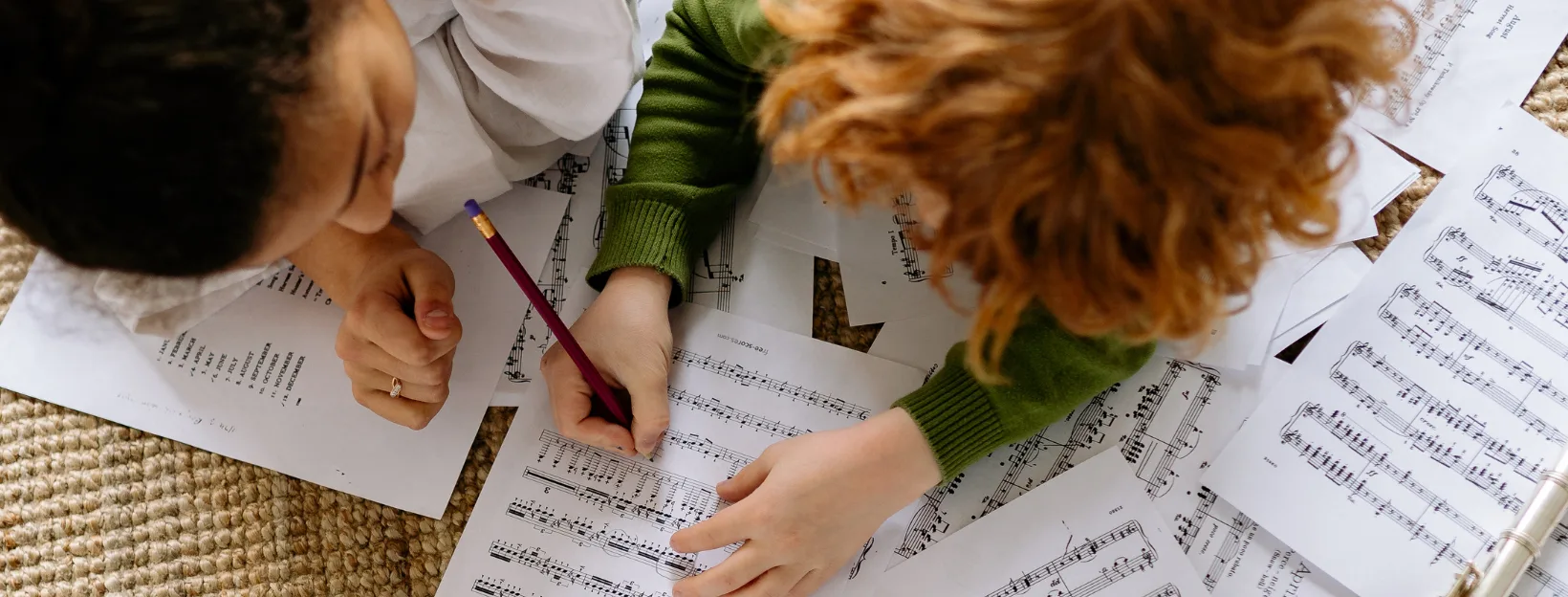
- Reading notation (visual processing)
- Translating notation into motor commands (visual-motor integration)
- Executing fine motor movements (motor cortex, cerebellum)
- Monitoring the sound produced (auditory processing)
- Comparing produced sound to intended sound (error detection)
- Adjusting in real time (executive function)
- Maintaining timing with internal beat or ensemble (temporal processing)
- Often, doing this bimanually with different hand coordination (interhemispheric communication)
Few activities engage this many systems simultaneously. The brain adapts to the training with structural changes in the regions most engaged — which include auditory cortex, motor cortex, cerebellum, corpus callosum, and prefrontal cortex.
The effects are dose-dependent: more training hours = more change. And they're stage-dependent: training started before roughly age 7 produces different effects than training started later, because certain aspects of auditory and motor cortex plasticity are higher in the earlier years.
One finding that reframes the conversation: children who undergo even 1–2 years of early music training show persistent effects on auditory processing and language-related brain function decades later, whether or not they continue playing. (3) The brain changes that early music training produces aren't fully reversible — they leave neural traces that persist into adulthood.
At Avaneuro, the Music & Musical Training module covers how to structure music education for developmental benefit, including the age windows, instrument choices, and practice patterns that produce the most neural adaptation.
Music Training and Reading
One of the most practical connections: music training supports reading development.
The mechanism goes through auditory processing and phonemic awareness. Phonemic awareness — the ability to identify and manipulate the individual sounds in spoken words (covered in the reading neuroscience article) — is one of the strongest predictors of reading success.
Music training, particularly rhythmic training and training in any pitched instrument, builds auditory discrimination and temporal processing skills that overlap with phonemic awareness. Children who take music lessons show improved phonological skills and faster reading acquisition than matched non-musical controls. (2)
For children with dyslexia or reading struggles, music training has emerged as a legitimate supplementary intervention. Not a replacement for structured literacy instruction, but a parallel input that strengthens the same underlying auditory-linguistic systems.
The practical parent framing: if you're considering music lessons for your child, the reading benefit is one more reason to do it — beyond the musical skill itself.
The Myths That Are Costing You
Myth #1: "Mozart effect' — play classical music to your baby for brain boost."
The "Mozart effect" from the 1990s — a brief cognitive enhancement from listening to Mozart — was misrepresented and mostly debunked. Passive listening to music, especially in infancy, has small and transient effects. The "play classical music to your baby" industry that followed wasn't supported by the actual research.
What does produce lasting effects: active music training. Learning to play an instrument, learning to sing with pitch, learning to move rhythmically. Passive listening is nice but not the mechanism.
Myth #2: "You have to start by age 3 for it to matter."
Early start is advantageous for certain aspects (absolute pitch acquisition, some motor coordination), but music training produces cognitive benefits across a wide age range. Starting at 6 or 8 still produces substantial brain adaptation, and even teenagers and adults taking up music show measurable neural changes.
Don't let "we missed the early window" prevent starting. The best time was age 4; the second-best time is now.
Myth #3: "Any music lesson is the same."
Quality matters. Some music instruction focuses on rote note reading without developing broader musicianship; other approaches (Suzuki, Kodaly, Dalcroze, classical pedagogy) are more comprehensive. For the cognitive-development benefits discussed here, you want instruction that includes:
- Ear training / auditory skill development
- Rhythm and timing work
- Expression and interpretation, not just mechanical execution
- Some theory for older children
- Regular performance or ensemble opportunity
Myth #4: "Piano is the only instrument that really matters."
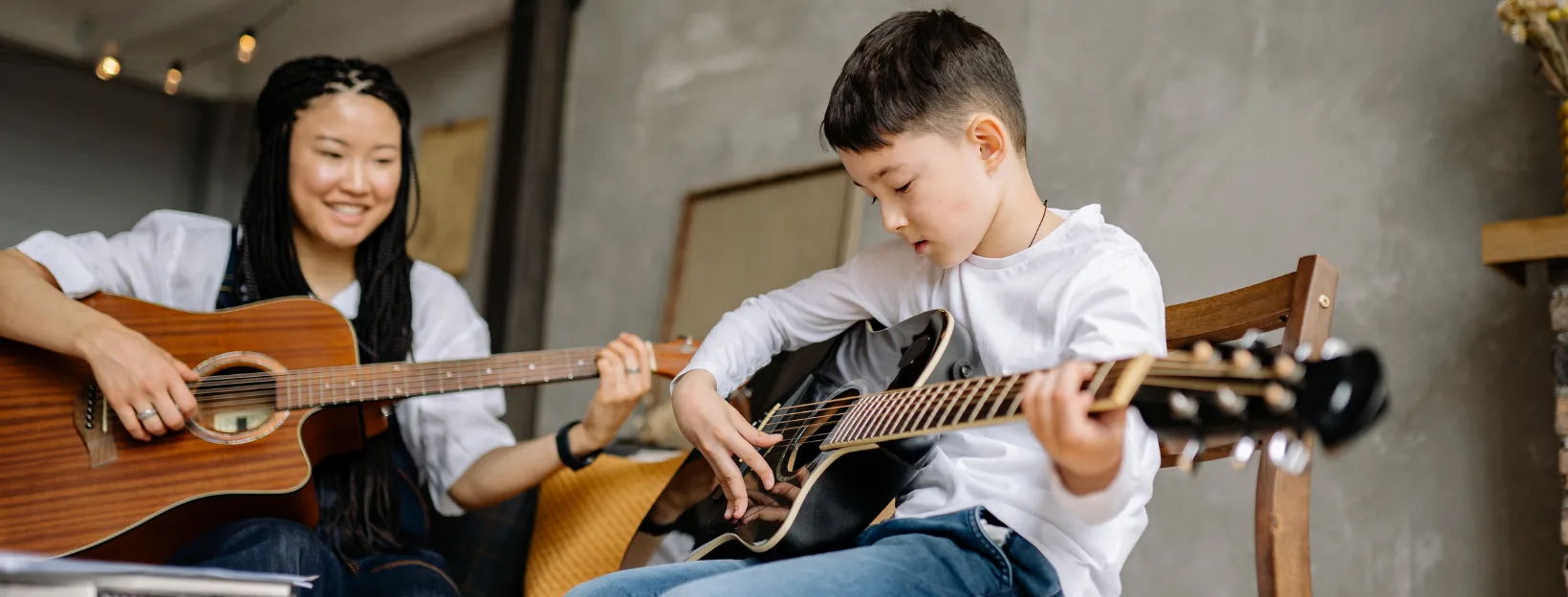
Multiple instruments produce the cognitive benefits. Piano has advantages (visual layout, two-hand independence, ability to play harmonies easily) but other instruments — violin, cello, guitar, winds, voice — all produce the brain adaptations. The right instrument is the one your child will actually enjoy enough to practice.
Percussion and drums, often dismissed as "less serious," produce excellent rhythmic and timing benefits and are highly engaging for many kids.
The Numbers That Matter
| What's happening | The data | Source |
|---|---|---|
| Gray matter increases in musicians | Documented in motor, auditory, and visual-spatial regions | (1) |
| Music training and phonological skills | Training causes (not just correlates with) improvement | (2) |
| Persistent effects of early music training | Long-term auditory-cognitive effects even after stopping | (3) |
| Dose-response | More practice hours → more brain adaptation | (1) |
| Age sensitivity | Earlier start, larger effect on some measures (not all) | (3) |
Wait, Really? Singing Counts

One under-appreciated form of music training: singing.
Singing engages:
- Pitch matching (auditory-motor integration)
- Breath control (diaphragm, phrasing)
- Rhythmic precision
- Lyric processing (language)
- Expression (emotional regulation)
Children who sing regularly — in school choirs, at home, with family — get many of the benefits of instrumental training without needing to learn an instrument, at a much lower cost.
For young children specifically, singing and rhythm activities are accessible entry points to music training. Kids don't need to be "musical" to benefit; they just need regular engagement with making sound with intention.
The Avaneuro Music module includes singing-based protocols for pre-instrumental children — because the cognitive benefits of musical engagement don't require a $2,000 violin.
What Actually Works
1. Start exposure early, formal training when ready. Infants and toddlers: sing to them, dance with them, expose them to diverse music, let them bang on pots and shakers. Ages 4–6: informal music programs (Suzuki early childhood, Music Together, Kindermusik) introduce structured musicianship. Age 5–7+: formal lessons on an instrument.
2. Choose an instrument they'll actually engage with. Consider temperament, physical aptitude, family logistics, and — importantly — the child's preference. Forced instrument choice often produces a resentful quitter by age 10.
3. Daily practice, short sessions. Music training works through repeated consolidation. Ten minutes of daily practice is far more effective than 90 minutes once a week. Make it ritual — same time, same place, every day.
4. Group classes and ensemble for social and motivational benefits. Solo practice alone has limits. Ensemble playing, classes with peers, and performance opportunities keep motivation high and add social dimensions to the training.
5. Don't over-pressure for excellence. The cognitive benefits accrue from the training regardless of whether the child becomes a professional. A child who enjoys playing at an intermediate level for years gets more benefit than a child who trained hard for a year and then quit out of burnout.
6. Include singing and rhythm in daily life. Family singing. Clapping rhythms. Dance parties. These engage the same systems and build base musicianship that makes later formal training easier.
7. Sustain for multiple years. The structural brain changes come from sustained training — typically years, not months. Plan for a long runway: the first year is often hardest; the benefits accumulate in years 2-5+.
8. For reading struggles, consider music as supplementary intervention. Music training supports phonological development and auditory processing. Not a substitute for structured literacy intervention, but a useful parallel for kids with reading difficulties.
9. Invest in a good teacher over a fancy instrument. Good pedagogy with a cheap instrument beats poor pedagogy with a Stradivarius. Find someone who works well with children and understands musicianship, not just note-reading.
10. Model musical engagement. If parents play, sing, or meaningfully engage with music, kids absorb this as normal. Your own relationship with music matters for theirs.
The Bottom Line
Music training is one of the clearest examples of a childhood enrichment that does what the research says it does. The brain changes are real, the cognitive spillover (especially to language and executive function) is documented, and the effects persist across decades.
The intervention requires sustained parental support — instrument rental, lessons, daily practice, patience through the difficult phases — but the cost-to-benefit is favorable. It's also one of the few enrichments that contributes to social/emotional skills (ensemble work, performance courage, persistence through difficulty) alongside the cognitive benefits.
At Avaneuro, the Music & Musical Training module covers age-appropriate entry points, curriculum selection, practice structure, and integration with academic development. Because "music is good for kids" is generic; "here's how to actually make music training work in a modern family schedule" is actionable.
Your child's brain is waiting to be shaped by music. It's waiting, in particular, for the active, engaged, sustained kind — not for you to play Mozart while they sleep. Pick an instrument. Start.
Go deeper: This article builds on Avaneuro's Music & Musical Training module — the full protocols, tools, and cited evidence base.
Related reading
- Handwriting Builds the Brain in Ways Typing Never Will
- The Neuroscience of Reading: Why Phonics Isn't Optional
- Bilingualism: The Cognitive Superpower Hiding in Plain Sight
- Screen Time Is Rewiring Your Child's Brain. Here's What the Research Actually Says.
References
- Gaser, C. & Schlaug, G. (2003). Brain Structures Differ Between Musicians and Non-Musicians. Journal of Neuroscience, 23(27), 9240–9245. https://pubmed.ncbi.nlm.nih.gov/14534258/
- Moreno, S., et al. (2009). Musical Training Influences Linguistic Abilities in 8-Year-Old Children: More Evidence for Brain Plasticity. Cerebral Cortex, 19(3), 712–723. https://pubmed.ncbi.nlm.nih.gov/18832336/
- White-Schwoch, T., et al. (2013). Older Adults Benefit from Music Training Early in Life: Biological Evidence for Long-Term Training-Driven Plasticity. Journal of Neuroscience, 33(45), 17667–17674. https://pubmed.ncbi.nlm.nih.gov/24198359/