Screen Time Is Rewiring Your Child's Brain. Here's What the Research Actually Says.
Nine minutes of fast-paced cartoons measurably impaired 4-year-olds' executive function. Night Shift doesn't fix it. "Educational apps" don't fix it. Here's what does.
You're holding the iPad like it's a live grenade you haven't decided how to defuse. Every parent I know has been there. Your kid is melting down in the grocery store, or you have a 20-minute call, or it's raining for the third straight day, and you hand over the screen and hope.
Hope that Cocomelon isn't really frying their brain. Hope that "at least it's educational" is enough. Hope that because you downloaded the "approved" app, you're off the hook.
I'm not going to tell you to throw the tablet in a lake. The research is more interesting than that. But if you've been quietly wondering whether screens are doing something to your child's developing brain, the answer is: yes, measurably, and the effect depends almost entirely on variables most parents are getting wrong.
Here's the number that should reframe the whole conversation:
Just nine minutes of watching a fast-paced cartoon caused a statistically significant drop in 4-year-olds' executive function — measured immediately after — compared to kids who watched a slow-paced show or drew with crayons. (Lillard & Peterson, Pediatrics, 2011)
Nine minutes. That's shorter than one episode of most shows.
Your Child's Brain Is Wet Cement
Between ages 0–5, your child's brain is building itself at a pace it will never match again. Roughly a million new neural connections are forming per second during the earliest years. Which connections survive depends on which get used — a process called experience-dependent plasticity.
Translation: whatever your child does repeatedly, they are building a brain for.
Real-world play — blocks, mud, conversations, falling down, solving a problem — builds the kind of brain humans have had for 200,000 years. Screens, especially fast-paced algorithmic ones, build a different kind of brain. Not a broken one. Just a differently-wired one, and not in ways that serve the goals most parents have.
The most sobering piece of evidence isn't a behavior study. It's an MRI study.
Researchers at Cincinnati Children's scanned preschoolers (ages 3–5) and found that children with higher screen use — especially without parental co-viewing — had lower white matter integrity in brain regions responsible for language, executive function, and emergent literacy. Measurable. Visible. On the scan. (Hutton et al., JAMA Pediatrics, 2020)
White matter is the wiring. It's what makes different parts of the brain talk to each other fast enough to do hard things like reading, reasoning, and emotional regulation. And in this study, more screen time correlated with less of it.
You can't see that in your kid's behavior on a Tuesday afternoon. You see it in fifth grade when they can't sustain attention on a chapter book. At Avaneuro, we spend an entire module unpacking this — not to scare you, but because the window to build this wiring closes faster than most parents realize.
The Myths That Are Costing You
Myth #1: "Night Shift" makes screens before bed fine
It doesn't. Not even close.
Blue light is only one of three mechanisms by which screens destroy sleep. The other two — content arousal (their brain is still processing that Bluey episode at 10 PM) and time displacement (screens eat the window when sleep was supposed to start) — are completely unaffected by Night Shift, blue light glasses, or any filter. (Hale & Guan, Sleep Medicine Reviews, 2015)
Children with screens in their bedrooms sleep an average of 30 minutes less per night. That's not a rounding error. Over a year, that's the equivalent of losing weeks of sleep entirely. (Falbe et al., Pediatrics, 2015)
If you do one thing after reading this article, make it this: no screens in the bedroom. Not a TV. Not a tablet charging on the nightstand. Not a phone "for the alarm." The device physically leaves the room.
Myth #2: "Educational" apps are categorically good
Most aren't. A 2015 review of the top-grossing "educational" apps for children found the vast majority had no educational content validated by any developmental learning framework. Bright colors and a quiz screen are not the same as learning. (Hirsh-Pasek et al., Psychological Science in the Public Interest, 2015)
Worse, under age 2, children barely learn from screens at all. The same word taught by a person in the room vs. a screen produces dramatically different retention. Babies are wired to learn from other humans, and swapping in a tablet interrupts that circuitry. (Roseberry et al., Child Development, 2014)
The Avaneuro infant module goes deep on this — because the "educational app for my 18-month-old" category is one of the biggest marketing-to-parent scams in modern life, and the data is unambiguous.
Myth #3: It's about how much, not what
Partly true, mostly misleading. The "two hours a day" kind of guideline collapses content that has wildly different effects into one number.
Fast-paced, rapid-cut content (most algorithmic YouTube, short-form video, many animated shows) directly impairs executive function — the mental control system that lets a child sit still, follow multi-step directions, wait their turn, and regulate emotion. (Lillard & Peterson, Pediatrics, 2011)
Slow-paced, narrative content (Mister Rogers, Daniel Tiger, Bluey) doesn't produce the same deficit. Co-viewing — watching with your child and talking about it — flips some content from neutral to actually educational.
"Two hours of Bluey with Mom and a conversation" and "two hours of autoplayed YouTube Shorts in the car alone" are not the same experience. Treating them as equivalent is how you end up making rules that don't fit the actual problem.
Myth #4: My own screen use doesn't affect my child
It absolutely does. A landmark study on "technoference" — parents' phone use interrupting interactions with their children — found that greater parental phone use predicted more child behavioral problems, across age groups and income levels. (McDaniel & Radesky, Child Development, 2018)
Your child is watching you. When you pick up your phone mid-sentence, they experience it as disconnection. And the research shows it shows up in their behavior downstream. This is uncomfortable. It's also, in the experience of almost every parent who addresses it honestly, one of the highest-ROI behavior changes available.
The Numbers That Matter

Let's talk about what excessive screen time actually costs your child — measurably, in peer-reviewed data:
| What happens | The data | Source |
|---|---|---|
| Developmental delays | Children with more screen time at 24 months showed worse performance on developmental screening at 36 months (language, motor, social skills) | Madigan et al., JAMA Pediatrics, 2019 |
| White matter integrity | Higher screen use correlated with lower white matter integrity in language and literacy regions on MRI in preschoolers | Hutton et al., JAMA Pediatrics, 2020 |
| Brain connectivity | Reading books increases brain connectivity; screen-based media decreases it in the same regions | Horowitz-Kraus & Hutton, Acta Paediatrica, 2018 |
| Executive function | 9 minutes of fast-paced cartoons measurably impaired executive function in 4-year-olds | Lillard & Peterson, Pediatrics, 2011 |
| Sleep loss | Children with bedroom screens sleep ~30 min less/night | Falbe et al., Pediatrics, 2015 |
| Mental health (adolescents) | Higher screen time correlated with worse mental health, academic, and social outcomes in early adolescents (n = 11,875) | Paulich et al., PLoS One, 2021 |
| Parent-child relationship | More parental phone use → more child behavior problems (technoference effect) | McDaniel & Radesky, Child Development, 2018 |
Read that row about white matter again. You can see the effect of screens on a brain scan.
This isn't "screens are evil." It's that screens compete directly with the experiences that build a kid's brain, and in most modern households, screens are winning. The good news: the fix isn't complicated. It's just unpopular.
Wait, Really? The Autoplay Is Doing Something Specific
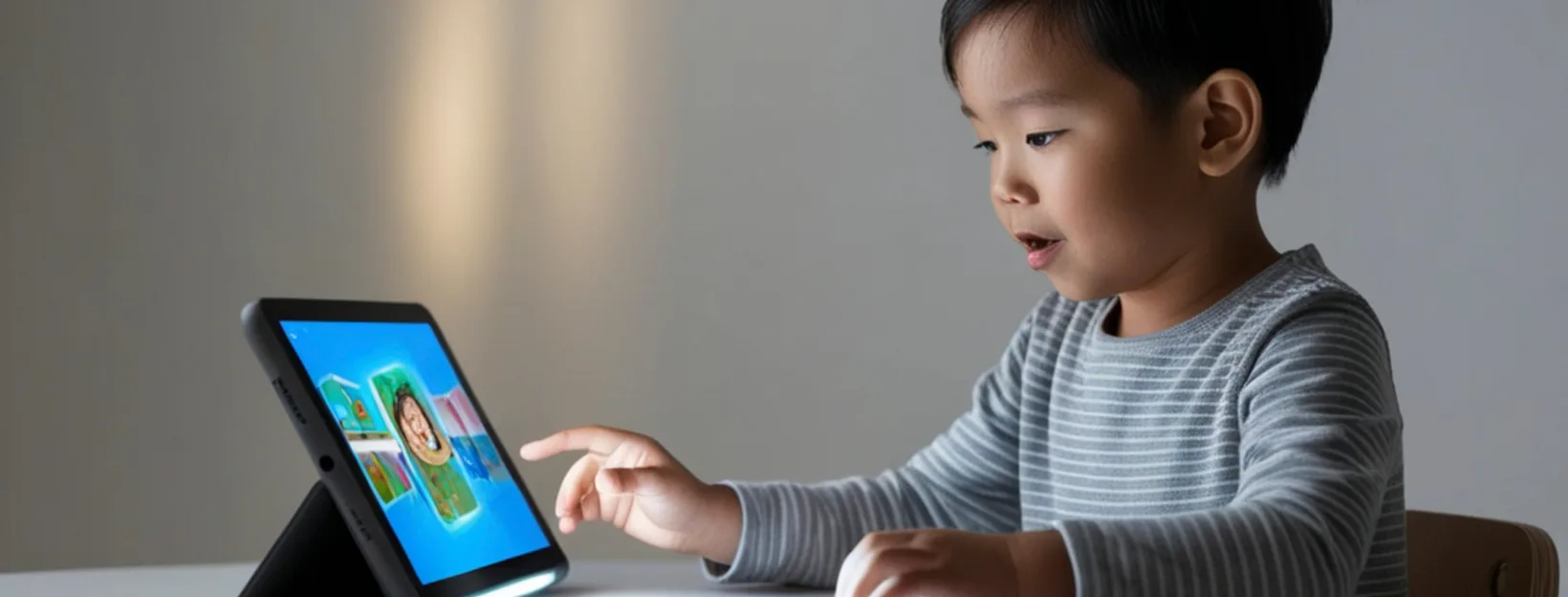
Here's the piece that doesn't get talked about enough.
Short-form video platforms (TikTok, YouTube Shorts, Reels) are engineered for what behavioral psychologists call a variable-ratio reinforcement schedule — the same mechanism that makes slot machines addictive. Every swipe might be the best video your child has ever seen. Or it might be boring. They don't know. So they keep swiping.
This isn't an accident. These apps are built by teams of behavioral scientists with explicit goals around session length and retention. They are, functionally, more optimized to capture a 6-year-old's attention than a 6-year-old's prefrontal cortex is equipped to resist. That's not a moral failing on your kid's part. That's asymmetric warfare.
And here's what makes it worse: in a large cross-sectional study of 11,875 early adolescents from the ABCD Study, more screen time was associated with more externalizing and internalizing problems, worse sleep, and worse academic outcomes — even at modest amounts. The relationship held after controlling for income, race, and parental education. (Paulich et al., PLoS One, 2021)
The Avaneuro Screen Time & Digital Wellness module walks parents through the specific app-by-app risk profile — because "limit screen time" isn't useful advice when 40 minutes on a creative coding app and 40 minutes on algorithmic short-form video produce completely different outcomes.
What Actually Works

I'm not going to tell you to be "more intentional." Here's the research-backed list:
1. No screens in bedrooms. Period. Not a TV. Not a tablet. Not a phone. This alone buys back 20–30 minutes of sleep per night — and sleep is the single highest-leverage intervention on your child's development. (Falbe et al., 2015) Every device charges in a common area. Yes, the teenagers will protest. Stand firm.
2. No screens 60+ minutes before bed. Not on Night Shift. Off. The psychological arousal from content keeps the brain activated long after the screen goes dark. Sub in a bath, an audiobook, a physical book, or literally staring at the ceiling.
3. Co-view with kids under 6. If a young child is going to watch, watch with them. Talk about what's happening. Ask questions. This flips screen time from "absorbing content" to "shared learning," and the effect on language and executive function is measurable.
4. Cull the autoplay apps first. If you're going to remove one thing this week, remove the short-form-video apps from kids' access. TikTok, YouTube Shorts/Reels, Instagram Reels. These are the most algorithmically engineered. Replace with slower-paced, narrative content with a clear start and end.
5. Do the phone thing for yourself, too. Put your own phone away when your child is with you. Not "put it face down on the table." Away. In another room if you can. The technoference research shows your child's behavior improves when you aren't half-present. This is the hardest one. It's also the most powerful. (McDaniel & Radesky, 2018)
6. Replace, don't just restrict. "Stop using the iPad" creates a vacuum. Fill it. Art supplies, books, outdoor access, a bike, a trampoline, a sandbox, a set of Legos, a deck of cards. The kids who do well without much screen time aren't suffering in silence — they have compelling alternatives. Build the alternatives first.
The Bottom Line
Screens aren't going away. Nobody's asking them to. The question isn't whether your child will use a screen — it's whether you understand what each hour is actually doing at the neural level, so you can make informed tradeoffs instead of guilty ones.
A child who uses a screen strategically — slow-paced content, co-viewed, with hard limits around sleep and mealtimes, and meaningful alternatives crowding in from the other direction — can thrive. A child whose screen time displaces play, sleep, conversation, movement, and boredom will not. That's not an opinion. That's the literature.
The parents I see navigating this best aren't the ones with the strictest rules. They're the ones who understand the why well enough that their kids understand it too — because the goal isn't a child who never touches a screen, it's a child who can self-regulate around one by adolescence.
At Avaneuro, we built out the Screen Time & Digital Wellness module specifically because "less is more" is not a plan. We walk through age-specific limits, content quality frameworks, the exact sleep-protection protocol, how to do the technoference audit on yourself, and a Family Media Plan template you can have written before the end of the weekend.
Because your child's brain is doing its most important work in the first decade of life — and screens are either supporting that work or competing with it. There's no neutral setting.
Go deeper: This article builds on Avaneuro's Screen Time & Digital Wellness module — the full protocols, tools, and cited evidence base.
Related reading
- The First 1,000 Days: The Most Important Window in Your Child's Life — And Most Parents Miss It
- Handwriting Builds the Brain in Ways Typing Never Will
- The Neuroscience of Reading: Why Phonics Isn't Optional
- Music Training Changes a Child's Brain. Literally.
References
- Lillard, A.S. & Peterson, J. (2011). The Immediate Impact of Different Types of Television on Young Children's Executive Function. Pediatrics, 128(4), 644–649. DOI
- Hutton, J.S., et al. (2020). Associations Between Screen-Based Media Use and Brain White Matter Integrity in Preschool-Aged Children. JAMA Pediatrics, 174(1), e193869. PubMed
- Horowitz-Kraus, T. & Hutton, J.S. (2018). Brain Connectivity in Children Is Increased by Reading Books and Decreased by Screen-Based Media. Acta Paediatrica, 107(4), 685–693. PubMed
- Madigan, S., et al. (2019). Association Between Screen Time and Children's Performance on a Developmental Screening Test. JAMA Pediatrics, 173(3), 244–250. PubMed
- Paulich, K.N., et al. (2021). Screen Time and Early Adolescent Mental Health, Academic, and Social Outcomes in 9- and 10-Year-Old Children. PLoS One, 16(9), e0256591. PubMed
- Hale, L. & Guan, S. (2015). Screen Time and Sleep Among School-Aged Children and Adolescents: A Systematic Literature Review. Sleep Medicine Reviews, 21, 50–58. DOI
- Falbe, J., et al. (2015). Sleep Duration, Restfulness, and Screens in the Sleep Environment. Pediatrics, 135(2), e367–e375. PubMed
- McDaniel, B.T. & Radesky, J.S. (2018). Technoference: Parent Distraction With Technology and Associations With Child Behavior Problems. Child Development, 89(1), 100–109. DOI
- Roseberry, S., et al. (2014). Skype Me! Socially Contingent Interactions Help Toddlers Learn Language. Child Development, 85(3), 956–970. DOI
- Hirsh-Pasek, K., et al. (2015). Putting Education in "Educational" Apps: Lessons From the Science of Learning. Psychological Science in the Public Interest, 16(1), 3–34. Link