Nitrate in Your Well Water: What Every Rural Parent Must Know About Blue Baby Syndrome
Unregulated private wells can harbor nitrate levels that trigger a life-threatening oxygen crisis in infants — here's what the evidence says and what to do about it.
The Problem Hidden in Plain Sight
If you live in a rural area and use a private well, your water looks clean. It probably tastes fine. But looks are genuinely deceiving here. Nitrate — a compound that leaches into groundwater from fertilizers and animal manure — has increased in water resources across many agricultural regions (Ward et al., International journal of environmental research and public health, 2018), and private wells are not subject to the routine monitoring that governs municipal water supplies. That gap in oversight matters enormously when you have an infant in the house.
The danger has a name that sounds almost archaic: methemoglobinemia, colloquially called "blue baby syndrome." It is not a historical curiosity. Physicians still see it (Fossen et al., Current problems in pediatric and adolescent health care, 2019), and understanding why infants are so specifically vulnerable — and what the emerging evidence says about subtler neurological risks — is something every rural parent deserves in plain language.
Why Nitrate Turns Hemoglobin Against Your Baby
Here is the basic biology. Nitrate ingested in water is converted in the gut to nitrite, which then oxidizes the iron in hemoglobin from its ferrous (oxygen-carrying) state to a ferric state, producing methemoglobin — a form that cannot transport oxygen to tissues (Fossen et al., Current problems in pediatric and adolescent health care, 2019). The result is systemic hypoxia and cyanosis, that characteristic slate-blue skin color that gives the syndrome its name (Zorc et al., Pediatric annals, 2001).
Infants are uniquely susceptible for three reasons that stack on each other. First, they consume far more water relative to body weight than older children or adults (Fossen et al., Current problems in pediatric and adolescent health care, 2019). Second, they have lower activity of NADH cytochrome b5 reductase, the enzyme that converts methemoglobin back to functional hemoglobin (Fossen et al., Current problems in pediatric and adolescent health care, 2019). Third, fetal hemoglobin — which makes up a significant portion of a young infant's hemoglobin — is more easily oxidized to methemoglobin than adult hemoglobin (Fossen et al., Current problems in pediatric and adolescent health care, 2019). Remove any one of these factors and the risk drops considerably. In a very young infant, all three are present simultaneously.
Clinical case reports document this tragedy going back decades. Two newborns were described in 1946 whose methemoglobinemia was traced directly to nitrates in well water (FERRANT et al., The Journal of pediatrics, 1946), and that same year researchers reported infants fed formula diluted with high-nitrate well water developing the condition (FAUCETT et al., The Journal of pediatrics, 1946). A 1950 Canadian report described well water cases in infants as well (MEDOVY et al., Canadian Medical Association journal, 1950), and later cases confirmed the pattern continues into the modern era (Miller et al., JAMA, 1971). Acquired methemoglobinemia has also been linked to nitrate-rich vegetables given in early infancy (Geffner et al., The Western journal of medicine, 1981).
The regulatory limit for nitrate in public drinking water — 10 mg/L as nitrogen — was set specifically to protect against infant methemoglobinemia (Ward et al., International journal of environmental research and public health, 2018). But that limit only applies where water is regularly tested. Private wells are a different story.
What "Safe" Actually Means — and Where the Threshold Gets Complicated
The 10 mg/L standard is designed as a floor, not a guarantee of complete safety. Several epidemiologic studies have observed increased risk at levels below that regulatory ceiling (Ward et al., International journal of environmental research and public health, 2018), which suggests parents should aim for the lowest feasible exposure rather than treating the legal limit as a comfort zone.
Pediatric nutrition guidance has gone further: recommendations have been made that water used to prepare infant formula contain less than 25 mg/L of nitrate to prevent methemoglobinemia (Vitoria et al., Anales de pediatria (Barcelona, Spain : 2003), 2004) — though note that this figure is expressed as nitrate (NO₃), not as nitrogen, which is a different unit. The more conservative 10 mg/L limit from U.S. regulations is expressed as nitrate-nitrogen. If you receive a well test result, confirm which unit the lab is reporting in; the numbers are not interchangeable.
One important nuance: not all sources of dietary nitrate carry the same risk. Vegetables contain nitrate in abundance but also contain antioxidants that may limit conversion to harmful N-nitroso compounds (Katan et al., The American journal of clinical nutrition, 2009). The concern in this article is specifically about water as the delivery vehicle, particularly when it is used to reconstitute powdered infant formula, because that concentrates the exposure in a feed that goes to one of the most vulnerable physiological systems imaginable.
The Emerging Neural Concern
Methemoglobinemia is the most acutely dangerous outcome, but it is not the only one worth tracking. The strongest epidemiologic evidence for adverse health effects of drinking water nitrate — beyond methemoglobinemia itself — includes neural tube defects (Ward et al., International journal of environmental research and public health, 2018). This is a prenatal risk, meaning it matters not just after your baby is born but during pregnancy. A developing fetal nervous system is forming its neural tube in the first weeks of gestation, often before a woman knows she is pregnant. Exposure to elevated nitrate during that window is the concern, not postnatal formula feeding.
One meta-analysis also found an association between drinking water nitrate intake and brain cancer and glioma (OR = 1.15, 95% CI: 1.06–1.24), though the authors call for further research and note that causality is not established (Essien et al., Archives of environmental & occupational health, 2022). This is not a reason for panic; it is a reason for prudent water testing, especially for women who are pregnant or planning to become pregnant and rely on a private well.
Recognizing Methemoglobinemia — Fast
Speed matters here. An infant with methemoglobinemia may appear bluish or gray, particularly around the lips and fingertips (Zorc et al., Pediatric annals, 2001). They may be lethargic, irritable, or breathing unusually fast. The key clinical distinction: this cyanosis does not resolve with supplemental oxygen the way respiratory causes of cyanosis do — because the problem is in the hemoglobin itself, not in the lungs (Zorc et al., Pediatric annals, 2001). If you see a blue infant, call emergency services immediately. Treatment with methylene blue is effective and typically produces rapid improvement when administered promptly (Geffner et al., The Western journal of medicine, 1981).
Breastfeeding is protective: it eliminates formula preparation with well water entirely. For families who cannot breastfeed, using certified bottled water to reconstitute formula is a reliable alternative while well testing is arranged (Fossen et al., Current problems in pediatric and adolescent health care, 2019).
Concrete Actions for Rural Families
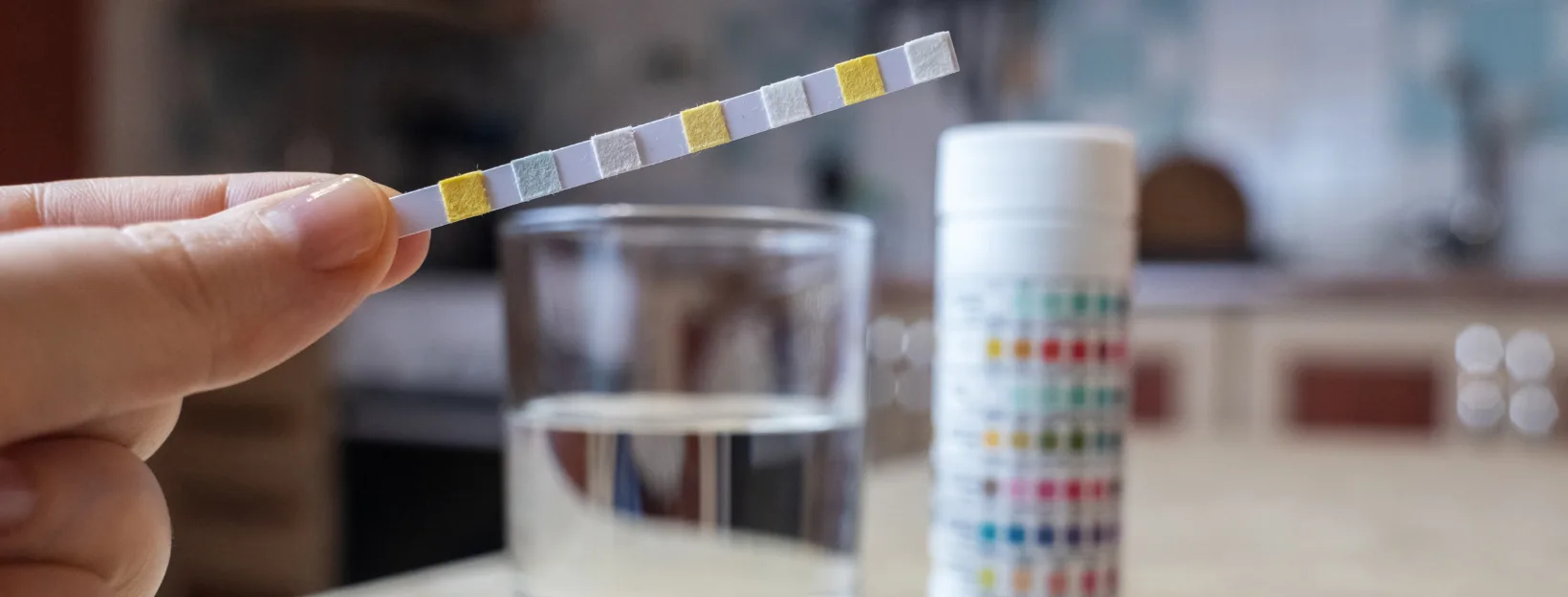
Test your well before your baby comes home. Ideally, test during pregnancy. A standard water quality panel from a certified laboratory will quantify nitrate levels. Most state health departments can direct you to a certified lab (Fossen et al., Current problems in pediatric and adolescent health care, 2019).
Tell your OB or midwife you use a private well. Clinicians should routinely ask about drinking water sources for pregnant patients and recommend nitrate testing for well users (Fossen et al., Current problems in pediatric and adolescent health care, 2019). If yours hasn't asked, raise it yourself.
Don't boil the water to remove nitrate. Boiling concentrates nitrate rather than destroying it — it is not the right fix. Use bottled water or a certified reverse-osmosis system if your well tests above safe levels (Fossen et al., Current problems in pediatric and adolescent health care, 2019).
Retest after heavy rain or flooding. Agricultural runoff is a primary driver of nitrate contamination (Ward et al., International journal of environmental research and public health, 2018), and single test results are snapshots. Annual testing is a reasonable minimum; test again after significant local flooding events.
Hold off on homemade vegetable purees very early. High-nitrate vegetables like spinach, beets, and carrots have been flagged as potential methemoglobinemia contributors in early infancy (Phillips et al., Food and cosmetics toxicology, 1971). Most guidelines recommend waiting until at least four to six months to introduce solid foods, which reduces this exposure window considerably.
Rural life carries real environmental exposures that urban parents rarely encounter. Well water nitrate is one of the most actionable of them — a genuine hazard that a simple, inexpensive lab test can either rule out or flag for intervention. Get the test. Know your number. And if your infant ever looks blue, don't wait.
Worried about your well water? Ask your pediatrician or state health department about certified nitrate testing labs in your area before your baby's first feed.
References
- Ward et al. (2018). Drinking Water Nitrate and Human Health: An Updated Review.. International journal of environmental research and public health. https://pubmed.ncbi.nlm.nih.gov/30041450/
- Fossen et al. (2019). Methemoglobinemia: Infants at risk.. Current problems in pediatric and adolescent health care. https://pubmed.ncbi.nlm.nih.gov/30956100/
- Zorc et al. (2001). A cyanotic infant: true blue or otherwise?. Pediatric annals. https://pubmed.ncbi.nlm.nih.gov/11641851/
- FERRANT et al. (1946). Methemoglobinemia; two cases in newborn infants caused by nitrates in well water.. The Journal of pediatrics. https://pubmed.ncbi.nlm.nih.gov/21002862/
- FAUCETT et al. (1946). Methemoglobinemia occurring in infants fed milk diluted with well water of high nitrate content.. The Journal of pediatrics. https://pubmed.ncbi.nlm.nih.gov/21002863/
- MEDOVY et al. (1950). Well water methaemoglobinaemia in infants.. Canadian Medical Association journal. https://pubmed.ncbi.nlm.nih.gov/15405935/
- Miller et al. (1971). Methemoglobinemia associated with well water.. JAMA. https://pubmed.ncbi.nlm.nih.gov/5108507/
- Geffner et al. (1981). Acquired methemoglobinemia.. The Western journal of medicine. https://pubmed.ncbi.nlm.nih.gov/7210666/
- Vitoria et al. (2004). [Drinking water in infants].. Anales de pediatria (Barcelona, Spain : 2003). https://pubmed.ncbi.nlm.nih.gov/14757021/
- Katan et al. (2009). Nitrate in foods: harmful or healthy?. The American journal of clinical nutrition. https://pubmed.ncbi.nlm.nih.gov/19458015/
- Essien et al. (2022). Drinking-water nitrate and cancer risk: A systematic review and meta-analysis.. Archives of environmental & occupational health. https://pubmed.ncbi.nlm.nih.gov/33138742/
- Phillips et al. (1971). Naturally occurring nitrate and nitrite in foods in relation to infant methaemoglobinaemia.. Food and cosmetics toxicology. https://pubmed.ncbi.nlm.nih.gov/4934610/