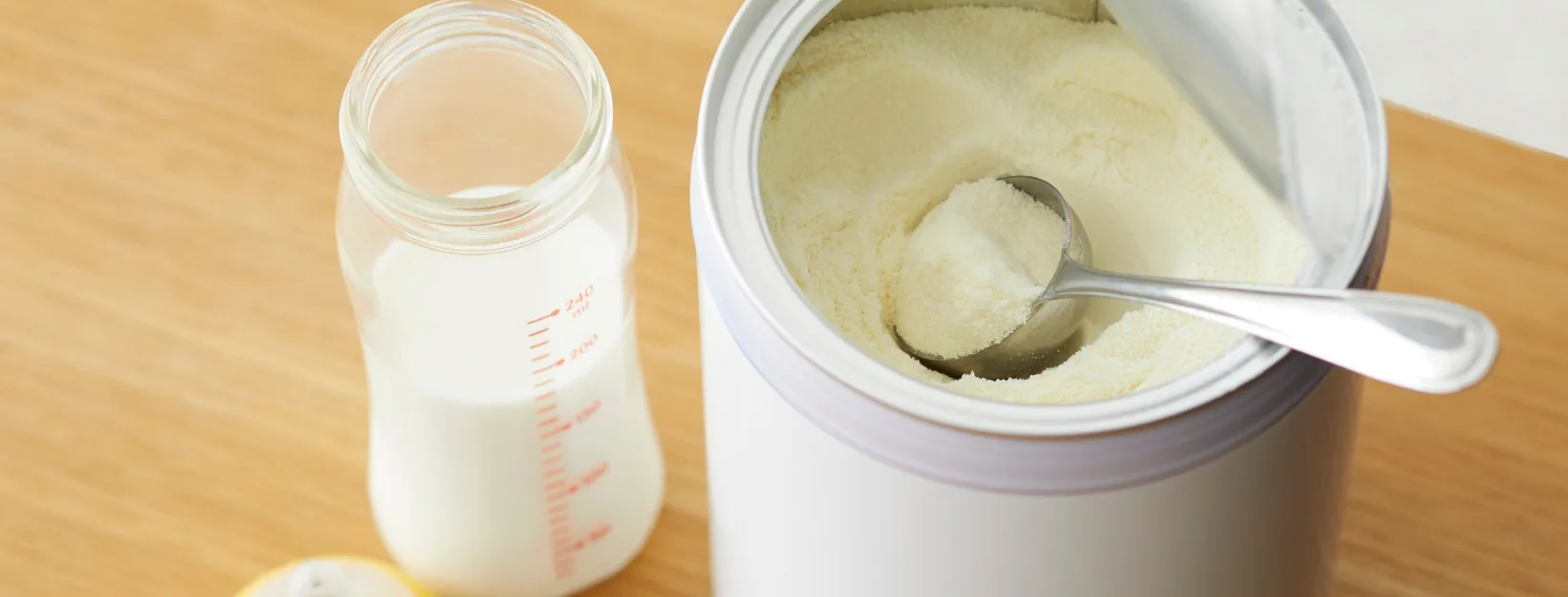
Taurine in Infant Formula vs. Breast Milk: What Parents Need to Know About This Brain-Building Nutrient
Why a little-known amino acid matters enormously in your baby's first months of life — and what it means if your child is formula-fed.
Taurine isn't a word most parents encounter until they spot it on a formula tin. Even then, it tends to blur into the long ingredient list alongside a dozen other unfamiliar compounds. But this small sulfur-containing amino acid has an outsized role in early brain development — and the difference between how much a breastfed baby gets versus a formula-fed baby gets has been the subject of serious scientific debate for decades.
Here's what the research actually shows.
What Taurine Is — and Why "Conditionally Essential" Matters
Taurine is technically a beta-amino acid, not incorporated into proteins the way most amino acids are. Instead, it exists freely inside cells, where it plays roles in bile acid conjugation, antioxidant defense, osmoregulation, and — critically for infants — neurodevelopment (Lourenço et al., Nutricion hospitalaria, 2002). It is the most abundant free amino acid in the human body (Aerts et al., Journal of Perinatal Medicine, 2002).
Healthy adults can synthesize taurine from methionine and cysteine, provided vitamin B6 is present (Lourenço et al., Nutricion hospitalaria, 2002). Newborns — especially preterm ones — cannot do this efficiently. Their enzymatic machinery for converting cysteine to taurine is immature, which means they depend almost entirely on dietary supply. That's precisely why researchers classify it as "conditionally essential" for infants: the body's own production is insufficient to meet demand during a critical window of growth (Chesney et al., Advances in Experimental Medicine and Biology, 1998; Gaull et al., Pediatrics, 1989).
How Breast Milk Delivers Taurine
Breast milk is a reliable taurine source. During pregnancy, taurine accumulates in maternal tissues specifically to be released — via the placenta prenatally and via milk postnatally — to the developing baby (Aerts et al., Journal of Perinatal Medicine, 2002). The fetal and neonatal brain accumulates taurine in particularly high concentrations, and brain taurine levels are highest at birth before falling as the nervous system matures (Chesney et al., Advances in Experimental Medicine and Biology, 1998).
Early work confirmed that human milk contains meaningful concentrations of taurine and characterized it as potentially a growth modulator for the developing infant (Gaull et al., Journal of Pediatric Gastroenterology and Nutrition, 1983). The implication is straightforward: a breastfed baby receives taurine passively through normal feeding, tracking closely with what the maternal body has prepared.
What Happens When Taurine Is Low
The consequences of insufficient taurine during the perinatal period are not trivial. Animal studies showed that taurine deficiency in mothers leads to growth retardation in offspring and impaired development of the central nervous system (Aerts et al., Journal of Perinatal Medicine, 2002). In preterm human infants, taurine insufficiency has been linked to impaired fat absorption, disrupted bile acid secretion, retinal dysfunction, and hepatic problems — all of which can be reversed with supplementation (Chesney et al., Advances in Experimental Medicine and Biology, 1998).
The neurodevelopmental signal is particularly striking. Low plasma taurine in neonates was associated with lower scores on the Bayley Mental Development Index at 18 months and lower arithmetic scores on the WISC-R at age 7 years (Wharton et al., Archives of Disease in Childhood: Fetal and Neonatal Edition, 2004). That's a long shadow for a deficiency in the first weeks of life. It's worth noting this is an association, not proven causation — but the signal is consistent enough to take seriously.
More recent prospective data from the Seychelles Child Development Study found associations between serum taurine concentrations in mothers and neonates and children's early neurodevelopmental outcomes (Beggan et al., Neurotoxicology, 2023). The picture is still being filled in, but the direction of evidence is consistent.
Taurine in Infant Formula: Where Things Stand
Early infant formulas based on cow's milk contained very little taurine relative to breast milk, because cow's milk is naturally low in it (Gaull et al., Pediatrics, 1989). Taurine supplementation of formulas began specifically to close this gap — described by one early review as "a measure of prudence" to provide infants with the same safety margin for taurine's physiological functions as human milk affords (Gaull et al., Pediatrics, 1989).
Today, taurine is added to many infant formulas, and analytical methods can now simultaneously verify taurine levels alongside other semi-essential nutrients like L-carnitine and choline (Bustamante-Rangel et al., Journal of the Science of Food and Agriculture, 2024). Yet supplementation is not universally mandated. A 2015 Spanish expert consensus using the Delphi method found no unified agreement among pediatric gastroenterologists and nutritionists on taurine supplementation in infant formulas — reflecting genuine remaining uncertainty, not negligence (Barrio et al., Anales de Pediatría, 2015). The authors of the Wharton study noted explicitly that taurine addition to formulas is not mandatory in all regulatory frameworks (Wharton et al., Archives of Disease in Childhood: Fetal and Neonatal Edition, 2004).
Very-low-birth-weight preterm infants face the greatest risk. Their kidneys cannot yet maximally conserve taurine through reabsorption, meaning they lose more via urine and have less reserve — making external supply even more critical than for term infants (Chesney et al., Advances in Experimental Medicine and Biology, 1998).
What This Means for Your Family
If you're breastfeeding, your milk is supplying taurine in a form calibrated to your baby's needs — one more reason to support breastfeeding duration when possible. Ensuring your own diet includes adequate protein and vitamin B6 supports your taurine status (Lourenço et al., Nutricion hospitalaria, 2002).
If you're formula-feeding, check your formula's ingredient list. Most reputable formulas sold in Europe, North America, and Australia do include taurine, but it is worth confirming — especially if your baby was born preterm. Ask your pediatrician or neonatologist directly whether the formula being used contains taurine, and whether the amount is appropriate for your child's gestational age and weight.
If your baby is on parenteral nutrition (intravenous feeding), this is a higher-stakes situation. Taurine depletion has been documented in patients receiving TPN without taurine supplementation, and preterm infants in this group are particularly vulnerable (Lourenço et al., Nutricion hospitalaria, 2002). This warrants an explicit conversation with your medical team.
The science here is not complete — researchers continue to work out exactly how much taurine the developing brain needs, at which developmental windows, and whether current formula levels are truly equivalent to breast milk. But the evidence for taurine's importance in neonatal brain and retinal development is strong enough that parents and clinicians should treat it as a nutrient worth tracking, not ignoring.
Questions about your baby's formula composition? Bring this article to your next pediatric visit and ask your provider to review the taurine content of your child's current formula.
References
- Aerts, L., et al. (2002). Taurine and taurine-deficiency in the perinatal period. Journal of Perinatal Medicine. https://pubmed.ncbi.nlm.nih.gov/12235714/
- Barrio, J., et al. (2015). [Expert consensus on the nutritional aspects of initial and follow-on infant formulas]. Anales de Pediatría. https://pubmed.ncbi.nlm.nih.gov/25801069/
- Beggan, E., et al. (2023). Associations between serum taurine concentrations in mothers and neonates and the children's anthropometrics and early neurodevelopment: Results from the Seychelles Child Development Study, Nutrition Cohort 2. Neurotoxicology. https://pubmed.ncbi.nlm.nih.gov/37634816/
- Bustamante-Rangel, M., et al. (2024). Simultaneous determination of semi-essential nutrients taurine, l-carnitine and choline in infant formulas and adult/pediatric nutritional formulas by hydrophilic interaction liquid chromatography-electrospray ionization-tandem mass spectrometry. Journal of the Science of Food and Agriculture. https://pubmed.ncbi.nlm.nih.gov/39392653/
- Chesney, R.W., et al. (1998). The role of taurine in infant nutrition. Advances in Experimental Medicine and Biology. https://pubmed.ncbi.nlm.nih.gov/9635063/
- Gaull, G.E. (1989). Taurine in pediatric nutrition: review and update. Pediatrics. https://pubmed.ncbi.nlm.nih.gov/2645571/
- Gaull, G.E., et al. (1983). Taurine in human milk: growth modulator or conditionally essential amino acid? Journal of Pediatric Gastroenterology and Nutrition. https://pubmed.ncbi.nlm.nih.gov/6417307/
- Lourenço, R., et al. (2002). Taurine: a conditionally essential amino acid in humans? An overview in health and disease. Nutricion Hospitalaria. https://pubmed.ncbi.nlm.nih.gov/12514918/
- Wharton, B.A., et al. (2004). Low plasma taurine and later neurodevelopment. Archives of Disease in Childhood: Fetal and Neonatal Edition. https://pubmed.ncbi.nlm.nih.gov/15499140/