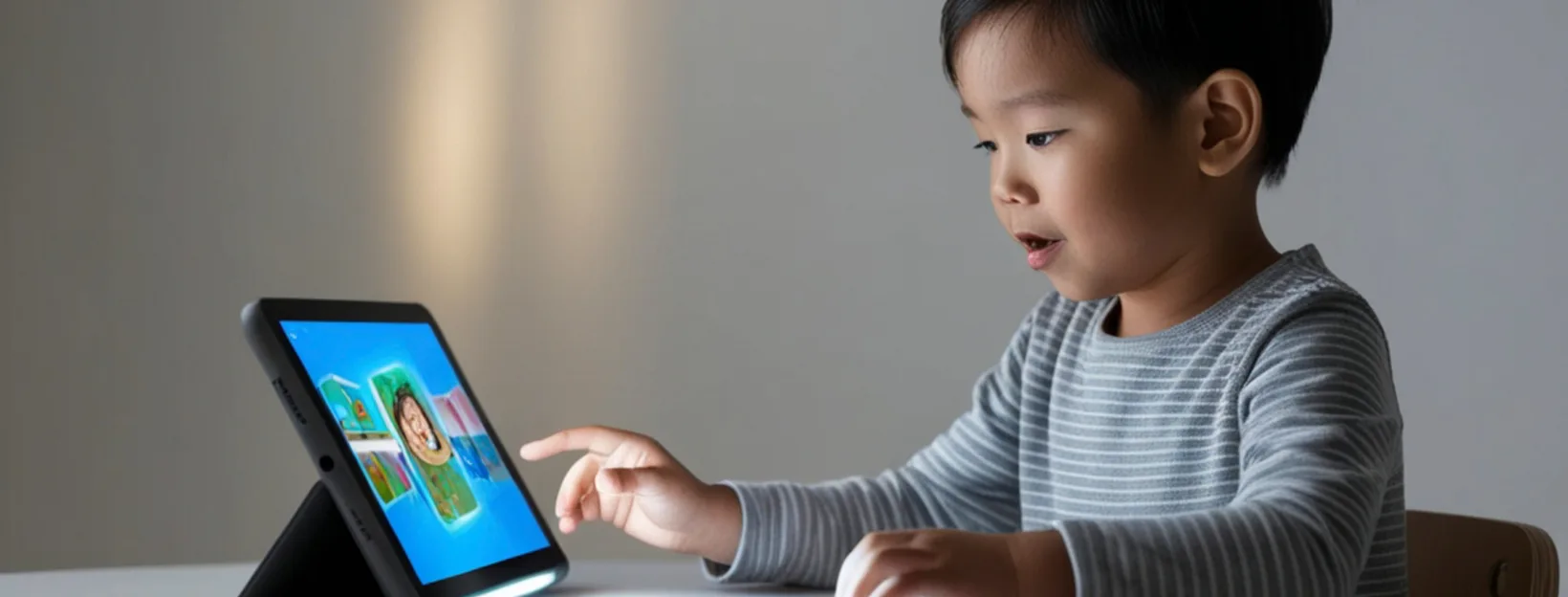
The Video Deficit Effect: Why Your Baby Learns From You, Not the Screen
Under-2s process live interaction and video very differently — here's what the research actually shows and what it means for your family.
Imagine you spend ten minutes teaching your 15-month-old where a toy is hidden. She finds it easily. Now imagine a stranger on a video does the exact same thing, with the same words, the same gestures, the same enthusiasm. She stares blankly and can't find the toy at all. Same information. Completely different result. This is the video deficit effect — one of the most consistent and practically important findings in early childhood research — and understanding it changes how you think about screens for babies.
What the Video Deficit Effect Actually Is
The video deficit effect describes a specific, well-documented gap: infants and toddlers under roughly 24 months learn significantly less from video content than from a live person presenting identical material. It isn't about attention — babies will happily watch a screen. It's about transfer: the ability to take what they've seen and apply it in the real world.
Researchers have demonstrated this across multiple types of learning, including object permanence tasks, imitation of actions, and word learning. The gap is not subtle. In word-learning studies, toddlers who struggle to acquire a new word from repeated video exposure often pick up the same word after a single live demonstration. The effect appears to weaken and largely disappear around age 2 to 2.5, which is part of why most professional guidance focuses specifically on the under-2 window.
Why Does It Happen? The Leading Explanations
No single mechanism fully explains the video deficit, but researchers have identified several contributing factors worth understanding.
Social contingency matters enormously. Live interaction is responsive. A caregiver looks where the baby looks, slows down when the baby seems confused, repeats what caught attention. Video cannot do this. The back-and-forth of joint attention — both people oriented toward the same thing at the same time — appears to be a powerful engine for early learning. When that contingency is removed, learning suffers. (Lovato et al., Frontiers in psychology, 2016)
Representation is harder from a flat screen. Very young children appear to have genuine difficulty understanding that a two-dimensional image stands for a three-dimensional reality. This "dual representation" challenge means that even when a baby watches a video carefully, she may not automatically connect what she sees on screen to the real objects and people in her world. (Lovato et al., Frontiers in psychology, 2016)
Familiarity helps, but only partially. Studies have tested whether using a familiar caregiver on video (rather than a stranger) narrows the gap. It does help somewhat — infants learn more from a parent on video than from an unfamiliar adult. But the live-person advantage persists even then, suggesting familiarity alone can't bridge the deficit. (Lovato et al., Frontiers in psychology, 2016)
Touch and physical interaction are part of the picture. Word learning in young children is closely tied to hands-on engagement with objects — the physical act of manipulating something while hearing its name strengthens the connection between label and referent. (Schroer et al., Advances in child development and behavior, 2024) Video removes that embodied component entirely.
What This Means for Language Development Specifically
Language is where parents most often wonder whether educational videos, apps, or programs might give their child a boost. The evidence is sobering. Under age 2, children appear to extract far less linguistic information from screen-based input than from live conversation. (Lovato et al., Frontiers in psychology, 2016)
This doesn't mean a child watching a screen learns nothing. Background speech from television may still expose children to some vocabulary. But the conditions that make language learning efficient — eye contact, contingent responses, pointing, shared reference, physical context — are precisely the conditions that live interaction provides and video cannot replicate. (Schroer et al., Advances in child development and behavior, 2024)
There's also an opportunity cost worth naming honestly. Time with a screen is time not spent in conversation with a caregiver. For a developmental window this sensitive, that trade-off matters.
How Children With Developmental Differences May Be Affected
Research on how children with intellectual disabilities acquire language highlights how important distributional cues in natural speech are for building word knowledge. (Kover et al., Language, speech, and hearing services in schools, 2018) These findings reinforce a broader principle: the richness and responsiveness of live, conversational input is difficult to replace regardless of a child's developmental profile. Parents of children with developmental differences may have additional reasons to prioritize face-to-face interaction over screen-based alternatives, though individual circumstances always warrant discussion with a specialist.
What About Touch Screens and Interactive Apps?
Touch screens occupy a genuinely different category from passive video, and the research here is less settled. (Lovato et al., Frontiers in psychology, 2016) Interactive apps can respond to a child's input, which introduces at least a limited form of contingency. Some studies suggest toddlers show slightly better learning outcomes from interactive touch-screen tasks than from equivalent passive video.
That said, the evidence for meaningful learning benefits from apps in under-2s remains thin. (Lovato et al., Frontiers in psychology, 2016) Interactivity on a screen is not the same as social interactivity with a person who can read your cues, follow your gaze, and adjust in real time. The video deficit effect appears to shrink but not disappear with interactive formats for the youngest children. Researchers continue to investigate this, and it would be premature to conclude that a well-designed app closes the gap with live interaction.
Practical Takeaways for Parents
None of this is cause for alarm if your baby has watched some television or you've used a video call with grandparents. The research describes averages across conditions, not permanent harm from any individual exposure. Here's what the evidence actually supports:
Video calls are a partial exception. Live video calls — where an adult on the other end responds contingently to your baby — are meaningfully different from recorded video. The contingency is real, even if imperfect. Grandparents on FaceTime are not the same as a passive cartoon. (Lovato et al., Frontiers in psychology, 2016)
Quantity matters more than content quality for this age group. The deficit applies broadly, not just to low-quality programs. Even well-produced, slow-paced, narrated content for infants shows the same learning gap compared to live interaction. Choosing "educational" videos for a 14-month-old does not solve the underlying problem.
Prioritize conversation during everyday routines. Bath time, mealtimes, diaper changes, walks — these are high-value language environments precisely because they involve joint attention, physical context, and contingent response. (Schroer et al., Advances in child development and behavior, 2024) They don't require special effort or materials.
Support hands-on word learning. Because physical manipulation of objects strengthens the link between a word and its meaning, everyday play that involves touching and handling real things while talking about them gives young children a learning advantage that screens cannot replicate. (Schroer et al., Advances in child development and behavior, 2024)
After age 2, the picture changes. The deficit weakens substantially as children develop better dual-representation skills and greater social sophistication. Screen time guidelines and research findings shift meaningfully around this boundary, which is why under-2 is treated as a distinct developmental window.
The video deficit effect is not a reason to feel guilty about past screen exposure. It's a reason to be confident about something simpler: your voice, your face, your hands pointing at things, your responses to your baby's gaze — these are genuinely irreplaceable in a way that no screen technology has yet managed to match.
Talk to your pediatrician if you have concerns about your child's language development or screen time habits. Every family's situation is different, and guidelines are starting points, not verdicts.
References
- Lovato et al. (2016). Young Children Learning from Touch Screens: Taking a Wider View.. Frontiers in psychology. https://pubmed.ncbi.nlm.nih.gov/27486421/
- Schroer et al. (2024). Word learning is hands-on: Insights from studying natural behavior.. Advances in child development and behavior. https://pubmed.ncbi.nlm.nih.gov/39074925/
- Kover et al. (2018). Distributional Cues to Language Learning in Children With Intellectual Disabilities.. Language, speech, and hearing services in schools. https://pubmed.ncbi.nlm.nih.gov/30120444/