
Creativity Is a Trainable Skill. Here's the Research.
The Torrance Tests of Creative Thinking — administered to American children since the 1960s — have shown a measurable decline in creativity scores since the 1990s. The cause isn't mysterious. And the fix is known.
Most parents treat creativity as a personality trait — something their child either has or doesn't. Creative kid, analytical kid. Born artist, born engineer.
The research on creativity says otherwise. Creativity is a set of skills that can be measured, trained, and improved through specific practices. And at the population level, American children's creativity has been declining measurably since the mid-1990s, per the Torrance Tests of Creative Thinking, which have been administered to children for decades. (1)
The hypothesized causes — increased structured time, reduced unstructured play, heavy testing regimes in schools, more screen-based passive content, less outdoor and mixed-age play — are all environmental, not genetic. Which means the decline is reversible at the household level.
Creativity, as measured and as practiced, involves four subskills:
- Fluency — generating many ideas
- Flexibility — shifting between different kinds of ideas
- Originality — producing unusual/novel ideas
- Elaboration — developing ideas in detail
These can all be practiced. Children raised with substantial exposure to creativity-building conditions (open-ended play, diverse experiences, time for boredom, encouragement of unusual thinking, exposure to creative adults) score higher on creative thinking measures and, in long-term research, produce more creative output as adults. (2)
What Builds Creativity
The conditions that reliably produce creative development in children:
1. Unstructured time. Covered in the play article. Self-directed play is creativity's primary training ground.
2. Exposure to diverse experiences. Novel environments, new activities, varied social contexts. Creativity involves combining ideas; kids with more raw material to combine generate more novel combinations.
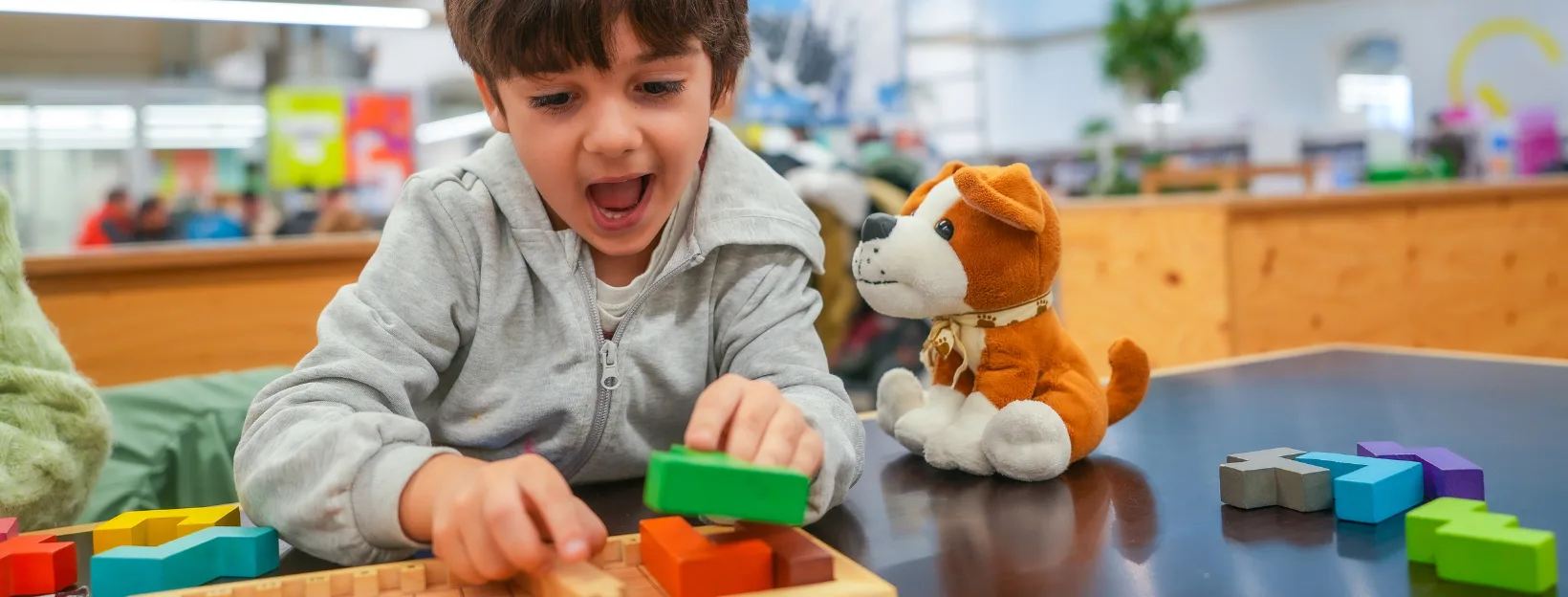
3. Open-ended materials. Blocks, art supplies, sand, water, sticks, boxes, fabric, found objects. The opposite of toys with one "correct" use. Open-ended materials require the child to decide what to do with them.
4. Permission to make mess. Creativity is inherently inefficient. Experimental. Sometimes the child's creative impulse produces a kitchen disaster or a destroyed cardboard box collection. Parents who can tolerate the mess foster more creative children.
5. Tolerance for weird output. The unusual drawing, the improbable story, the odd combination. Parental responses that engage seriously with the child's novel ideas — rather than redirecting toward more conventional output — signal that creativity is valued.
6. Exposure to creative adults. Parents, grandparents, teachers, neighbors who make things, invent things, tell stories, play music, experiment with cooking. Creative adults are models.
7. Arts exposure. Not just passive consumption but some active engagement — making art, music, theater, writing.
8. Reduced screen consumption. Heavy media consumption narrows imagination to the kinds of stories and images the media produces. Less screen time leaves room for self-generated imagination.
9. Nature exposure. Natural environments provide sensory diversity and open-ended affordances that built environments don't. Creativity seems to benefit from nature exposure across age groups.
10. Psychological safety. Fear inhibits creativity. Children who feel evaluated, judged, or pressured are less creative than those who feel safe to try and fail.
At Avaneuro, the Creativity & Problem-Solving module walks through specific protocols at each age for building these conditions — because the decline isn't inevitable and the fix is implementable at the family level.
The Myths That Are Costing You
Myth #1: "Creativity is genetic. Either they have it or they don't."
Partially heritable, yes. Highly responsive to environment, also yes. Population-level declines over decades cannot be explained by genetic change; they reflect environmental change. Individual-level variation also has substantial environmental contribution.
Don't pre-label your child. Create the conditions. Watch what develops.
Myth #2: "Art classes are the creativity intervention."
Art classes can be creative or can be instructional-and-restrictive. A class that teaches kids to copy examples precisely may develop skill without developing creativity. A class (or home environment) that provides materials and lets kids explore is more creativity-building.
The actual creativity-building activity is open-ended exploration, not following directions to produce a specific output.
Myth #3: "Structured activities build creativity."
Usually not directly. Structured activities (music lessons, sports, scheduled enrichment) have their own benefits but don't substitute for self-directed creative time. A kid in 6 structured activities with no free time is unlikely to develop creative capacity regardless of how "enriching" the activities are.
Myth #4: "Gifted kids are naturally creative."
Overlap, but not identity. Academic giftedness and creativity are related but distinct. Many high-IQ kids are conventionally successful but not creatively productive; many creative kids are not academically exceptional.
Cultivate creativity as its own skill set, not as a byproduct of other cognitive development.
The Numbers That Matter

| What's happening | The data | Source |
|---|---|---|
| Torrance Tests decline over decades | Measurable population-level decline in American children since ~1990 | (1) |
| Play and creativity | Play-based activities reliably boost creative thinking measures | Play research |
| Creativity and later outcomes | Creative thinking in childhood associated with later creative and academic outcomes | (2) |
| Nature exposure and creativity | Time in nature improves creative performance | Environmental psychology |
Wait, Really? Schools May Be Part of the Problem

A controversial but well-supported claim in creativity research: American schools have gotten better at teaching convergent thinking (one right answer) and worse at fostering divergent thinking (many possible answers).
Increased testing pressure. Reduced recess and free time. Standardized curricula that punish unusual answers. Incentives for schools and teachers to produce measurable outcomes on narrow metrics. All of this reduces the space for creative exploration in the school day.
Creative children often underperform in highly-standardized schools, which can make parents mistakenly think the child "isn't bright." Usually, they're fine — they're just better suited to environments that value novel thinking more than conforming correctness.
For parents observing this dynamic, the interventions are: protect substantial creative time at home, supplement with environments that value creative output (arts programs, maker spaces, certain kinds of Montessori or project-based schools), and don't let the child internalize the "I'm not smart because I struggle with fill-in-the-bubble tests" narrative.
The Avaneuro Creativity module addresses how to build creative capacity alongside (or despite) a conventional school environment.
What Actually Works
1. Unstructured time, defended. Covered in the play article. Non-negotiable.
2. Open-ended materials, always accessible. Art supplies. Blocks. Cardboard boxes. Tape. String. Clay. Loose parts. The accessibility matters — if materials are locked up, they don't get used.
3. Tolerate mess. Part of creating conditions for creativity is accepting that creative work produces mess. Teach cleanup as part of creative practice; don't prevent the creativity to preserve the kitchen.
4. Engage with unusual ideas. When your kid tells you the unusual story or produces the weird drawing, engage with the content seriously. "Tell me more about this" is more creativity-building than "That's nice, sweetie."
5. Reduce screen time. Especially passive screen time. Consumption crowds out creative output. This doesn't mean zero screens; it means "substantially less than the default" for most families.
6. Nature exposure. Covered in the outdoor time article. One of the most creative-output-provoking environments available to most kids.
7. Make alongside your kid. Cooking experiments. Woodworking. Gardening. Music. Writing. Creative adults produce creative children more reliably than non-creative adults with all the right intentions.
8. Maker-space access. If available, libraries with maker spaces, community centers with creative programs, or household spaces reserved for creative work. Having somewhere to make reliably produces more making.
9. Age-appropriate creative constraints. Sometimes a specific constraint produces more creativity than no constraint. "Make something out of this one paper bag" or "Write a story using only these five words" — constrained creativity is its own useful exercise.
10. Don't evaluate the output. Creativity flourishes with minimal evaluation. "Is this good?" is the wrong question from both parents and children. "What are you trying to do?" "What comes next?" are better.
The Bottom Line
Creativity is one of the most valuable skills in a rapidly changing world — the skill most likely to matter in fields that don't exist yet. It's also declining at the population level because the conditions that build it are being crowded out of childhood.
Reversing the decline at the individual family level is doable. Unstructured time. Open-ended materials. Mess tolerance. Engaged adults. Reduced screen consumption. Nature. The interventions aren't exotic, but they require intentional opposition to the current default trajectory of over-scheduled, over-mediated, over-evaluated childhood.
At Avaneuro, the Creativity & Problem-Solving module provides the specific developmental-stage protocols and the integration with the broader program. Because a creative child isn't just more fun to raise — they're better positioned for a life they'll actually enjoy and contribute to in an unpredictable world.
Fewer activities. More boxes. Less cleanup perfection. More weird drawings on the fridge. The creativity grows from the conditions.
Go deeper: This article builds on Avaneuro's Creativity & Problem-Solving module — the full protocols, tools, and cited evidence base.
Related reading
- Working Memory Is the #1 Predictor of School Success. Here's How to Build It.
- The Neuroscience of Unstructured Play: Why Boredom Builds Better Brains
- Executive Function: The Single Skill That Predicts Everything
- Flow States in Children: The Underrated Driver of Mastery
References
- Kim, K.H. (2011). The Creativity Crisis: The Decrease in Creative Thinking Scores on the Torrance Tests of Creative Thinking. Creativity Research Journal, 23(4), 285–295. https://doi.org/10.1080/10400419.2011.627805
- Plucker, J.A. (1999). Is the Proof in the Pudding? Reanalyses of Torrance's (1958 to Present) Longitudinal Data. Creativity Research Journal, 12(2), 103–114. https://doi.org/10.1207/s15326934crj1202_3