
The Neuroscience of Unstructured Play: Why Boredom Builds Better Brains
The modern parenting impulse is to fill every moment with enrichment. The brain, it turns out, needs emptiness — unscheduled, unprogrammed time in which it has to organize its own activity — to build executive function.
Modern American childhood has quietly become one of the most scheduled periods in human history. Soccer. Music lessons. Enrichment classes. Educational apps. Screen time. Afterschool programs. Structured playdates. Each activity is optimizing something, filling the hours, producing some kind of output.
What this schedule has displaced is the thing many developmental researchers think matters more than any individual scheduled activity: unstructured, unsupervised, self-directed play.
Not "play where the adult sets up the activity." Not "play that has a learning goal." Not "constructive play with a defined outcome." Self-directed play — kids figuring out what to do, negotiating among themselves, making their own rules, following their own interest, building their own worlds — is the kind that develops executive function, creativity, social skills, and self-regulation in ways nothing else quite does.
And the research on play and developmental outcomes is consistent: the reduction in unstructured play over recent decades has tracked rising rates of childhood anxiety, reduced creativity, and measurable declines in executive function on age-normed tests. (1)
The proposal from developmental researchers like Peter Gray and others: part of what looks like a mental health crisis in young people is a play deficit. (2)
What Unstructured Play Actually Does
Self-directed play is cognitively dense. In any given hour of unstructured play, a child is simultaneously:
- Planning — what are we doing? What happens next?
- Negotiating — what are the rules? Who plays what role?
- Regulating emotion — dealing with frustration, disagreement, disappointment
- Taking perspective — understanding what the other kids want
- Problem-solving — what to do when something breaks or fails
- Taking appropriate risk — climbing the tree, trying the hard thing
- Managing attention — staying engaged with a self-generated activity
- Improvising — what to do when plans don't work
- Building motor skills — especially in outdoor unstructured play
This is, almost precisely, the developmental portfolio that predicts later life success — executive function, social skills, creativity, grit, self-regulation. Unstructured play is how these skills get practiced.
A scheduled activity, by contrast, has the adult doing most of the executive function work. The adult decides what to do, when to start, when to stop, what the rules are, how to resolve disputes, how to handle emotions. The child follows along. The developmental work is being done — by the adult.
This is why the current trend of "enrichment-heavy, low-unstructured-time" childhood produces kids who are competent at structured tasks and unexpectedly weak at self-direction when they hit college and adulthood.
At Avaneuro, the Play & Unstructured Time module treats free play as non-negotiable programming — not a frill to be cut when schedules get busy.
Boredom Is a Feature
One of the most counter-cultural ideas in the developmental-science community: boredom is developmentally important.
Boredom is what happens when the child's brain doesn't have external input dictating its activity. In this state, the brain's default-mode network engages — the same network active during daydreaming, reflection, creative insight, and self-referential thinking. The default-mode network is essential for creativity, self-understanding, and the integration of learning.
Children who are never bored — because there's always a screen, a scheduled activity, or an adult providing entertainment — rarely exercise this network. Which means they rarely develop the ability to generate their own direction from a blank slate.
The research-informed framing: don't rescue your child from boredom. Complaining-of-being-bored is usually the precursor to genuinely self-directed activity, if allowed to run its course. The parental impulse to solve the boredom ("let me find something for you to do") short-circuits the very cognitive work the boredom is triggering.
Sit with the boredom. Repeatedly. Over weeks. Watch what your child invents. This is often where real creativity starts.
The Myths That Are Costing You
Myth #1: "Unsupervised play is unsafe."
Risk is relative. Statistically, childhood is the safest it has ever been — unintentional-injury rates have fallen substantially over decades. Yet parental supervision is higher than at any point in history.
The gap between actual risk and perceived risk is large, and the "never unsupervised" standard deprives children of the self-direction experience while not making them meaningfully safer.
Reasonable unsupervised play — neighborhood or park play, within an age-appropriate range, with basic rules and check-in points — is developmentally valuable and statistically low-risk.
Myth #2: "They need adult-guided activities to learn."
Adult-guided activities are one kind of learning. Self-directed play is another. The two are complementary, not substitutes. Children who get both do better than children who get only one.
The current bias is heavily toward adult-guided, often at the exclusion of self-directed. Rebalancing is the intervention.
Myth #3: "Screens count as play."
Most screen use is not play in the developmental sense. Consuming content (videos, casual games designed for engagement loops) is not the same as self-directed creative activity.
Some kinds of screen use approach developmental play — Minecraft in creative mode, some open-ended games, creative software — but most of what kids do on screens is closer to consumption than play.
Myth #4: "They won't know what to do without direction."
If they've been over-scheduled their whole childhood, they may not — at first. Self-direction is a skill. A child who has never been bored, never had to invent what to do, and never had unstructured time will initially be bewildered by unstructured time.
Persist through the initial "I'm bored" phase. Provide a supportive environment with materials (art supplies, books, building toys, outdoor space, other kids) and confidence that your child will figure it out. Within days or weeks, most kids find their own direction — and once they do, they become voracious users of unstructured time.
The Numbers That Matter
| What's happening | The data | Source |
|---|---|---|
| Decline in free play over recent decades | Substantial reduction documented in multiple cultures | (2) |
| Association with youth mental health | Increased anxiety and depression correlated with reduced play | (2) |
| Executive function scores over time | Some measures showing declines in cohort studies | Developmental research |
| Creativity scores | Some declines documented in age-normed tests over decades | Creativity literature |
| Play and learning | Play-based learning as effective as or more than direct instruction for young children | (1) |
Wait, Really? Risky Play Is Protective

A finding that surprises many parents: risky play — climbing, jumping from heights, using tools, playing rough, exploring far from adults — is associated with lower anxiety, not higher. (3)
The mechanism: risky play lets children experience fear in manageable doses, develop motor skills for handling difficulty, learn their own body's capabilities, and practice regulating their own fear response. The children who never experience managed risk don't learn how to handle risk — which tends to produce higher, not lower, anxiety as they age.
Countries with more tolerance for risky play (Scandinavia, parts of Europe and Asia) report lower childhood anxiety rates than countries with the most restrictive supervision (U.S., U.K.).
This doesn't mean "let them do whatever." It means: tolerate reasonable risk. Climb the tree. Let them try the hard thing. Let them fall, within reason, and get back up.
The Avaneuro Play module includes a framework for age-appropriate risky play — because the research supports it and the current culture is pushing in the wrong direction.
What Actually Works
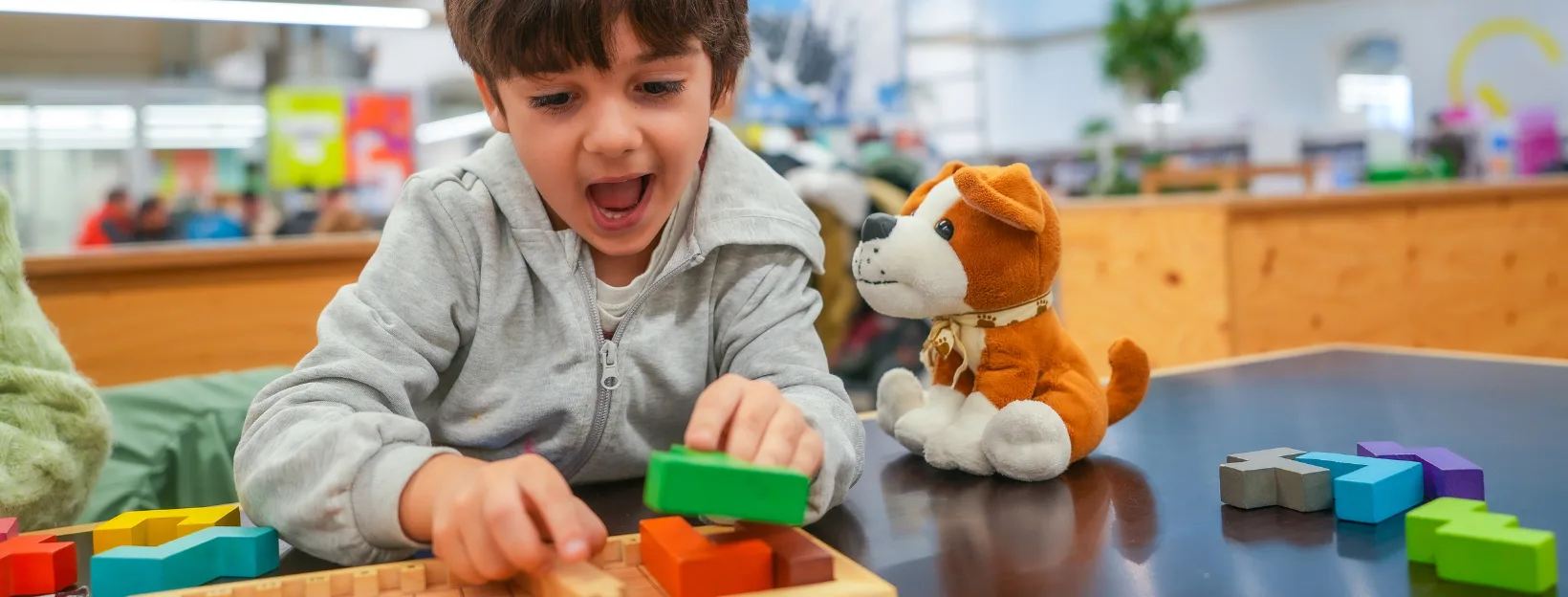
1. Protect substantial blocks of unstructured time. Not "45 minutes between piano and soccer." Multi-hour stretches with no scheduled agenda. Afternoons, weekends, summers.
2. Reduce the scheduled activity load. Most kids have too many scheduled activities. A good rule: one major commitment per season (one sport or one art), plus school and family life. Not three simultaneously.
3. Outdoor space, if possible. A backyard, a park, a woods. Outdoor play tends to be more self-directed than indoor play and delivers other benefits (covered in outdoor time article).
4. Provide materials, not activities. Art supplies always accessible. Books on shelves. Blocks and building toys. Outdoor gear. Dress-up clothes. The material environment shapes what play looks like.
5. Let them be bored. Don't rescue. "Find something to do" is a complete answer to "I'm bored." The creativity that follows is the point.
6. Let them play with other kids. Mixed-age play especially valuable. Older kids teach younger ones; younger ones learn social rules from older ones; both develop competencies that adult-led play doesn't build.
7. Reduce adult involvement during play. Supervise enough for safety. Beyond that, don't direct, don't coach, don't interrupt. Let the kids figure it out.
8. For kids who've forgotten how to play, restart gradually. Pull back scheduled activities. Reduce screen access. Provide materials and time. Resist the initial "I'm bored" protests. Most kids re-learn play within 2–6 weeks.
9. Risky play, calibrated. Climbing trees, bikes, swings, balancing on logs, using real tools (age-appropriately). A few bruises and scraped knees are evidence of developmental exposure, not parental failure.
10. Model unstructured time yourself. Adults who always structure their own time (scheduled from wake to sleep, filled with productivity) model that self-direction is abnormal. Kids observing parents who take walks without destinations, read without purpose, or garden for pleasure see unstructured time as normal adult life.
The Bottom Line
Unstructured play is not a nice-to-have. It's one of the most-densely-developmental activities a child can do, and the one modern childhood has most systematically reduced. The resulting deficit in executive function, creativity, self-regulation, and anxiety tolerance is showing up across the current generation of children and young adults.
The intervention is subtraction, not addition. Fewer scheduled activities. More tolerance for boredom. More outdoor access. More unsupervised time with peers. More materials and less direction. This is uncomfortable for the "optimizing parent" instinct, but it's what the developmental research consistently supports.
At Avaneuro, the Play & Unstructured Time module provides the framework for integrating this into a modern family life that has real constraints. Because the goal isn't to eliminate all structure — it's to restore the balance that current parenting culture has lost.
Put the kids outside. Take the screens away. Let them be bored. They'll figure something out. What they figure out will be the most developmentally valuable thing in their day.
Go deeper: This article builds on Avaneuro's Creativity & Problem-Solving module — the full protocols, tools, and cited evidence base.
Related reading
- Working Memory Is the #1 Predictor of School Success. Here's How to Build It.
- Executive Function: The Single Skill That Predicts Everything
- Creativity Is a Trainable Skill. Here's the Research.
- Flow States in Children: The Underrated Driver of Mastery
References
- Weisberg, D.S., et al. (2016). Guided Play: Principles and Practices. Developmental Psychology. https://doi.org/10.1037/dev0000035
- Gray, P. (2011). The Decline of Play and the Rise of Psychopathology in Children and Adolescents. American Journal of Play, 3(4), 443–463. https://eric.ed.gov/?id=EJ985541
- Brussoni, M., et al. (2015). What Is the Relationship Between Risky Outdoor Play and Health in Children? A Systematic Review. International Journal of Environmental Research and Public Health, 12(6), 6423–6454. https://pubmed.ncbi.nlm.nih.gov/26062040/