
Sensory Processing: Why Some Children Melt Down Over a Sock Seam
When a child refuses to wear a shirt because of the tag, they're not being difficult. Their sensory system is registering the tag as actually painful. Understanding sensory processing changes what the intervention should be.
Some children experience everyday sensory inputs — the seam in a sock, the tag on a shirt, the texture of mashed potatoes, the noise of a hand dryer, the bright lights of a grocery store — at intensities most people don't. To the outside observer, the child is being dramatic, picky, or difficult about the seam/tag/noise. To the child's nervous system, the input is genuinely overwhelming.
This is sensory processing, and it exists on a spectrum. All humans have a sensory processing profile — we're all more or less sensitive to various inputs. For some children (and adults), the variation is mild and manageable. For others, it's prominent enough to meaningfully affect daily life.
Roughly:
- Sensory over-responsive (SOR) kids: nervous system registers sensory input as more intense than average. Textures, sounds, lights, smells, temperatures feel overwhelming. Avoidance, distress, sometimes aggressive responses.
- Sensory under-responsive (SUR) kids: nervous system registers sensory input as less intense than average. May not notice pain, cold, hunger, or fullness reliably. May need more intense input to respond.
- Sensory seekers: actively seek more sensory input than typical — spinning, crashing, climbing, making loud noises, touching everything.
Many children have mixed profiles — over-responsive to some inputs, under-responsive to others, seeking certain inputs. Sensory profile is stable across time for the most part, though kids can develop coping strategies and learn to tolerate more.
The key parental reframe: sensory reactions are not behavioral choices. A child who melts down over a sock seam isn't choosing to be difficult. Their nervous system is actually producing the distress response the behavior looks like. This matters because the interventions that work for sensory issues look very different from the interventions that work for behavioral issues.
The Seven Senses (Not Five)
Most people learned five senses in elementary school. Sensory integration research recognizes at least seven, with the two "internal" ones often being the most clinically relevant:
The classic five:
- Sight
- Hearing
- Taste
- Smell
- Touch
The internal two:
- Proprioception — sense of body position and force. Where are my limbs? How hard am I pushing? Develops through movement, climbing, heavy lifting, pushing, pulling.
- Vestibular — sense of balance and spatial orientation relative to gravity. Develops through swinging, rolling, spinning, jumping, changing head positions.
Some frameworks add interoception — sense of internal body state (hunger, thirst, bathroom needs, emotional state).
Each of these senses has its own processing pathway, its own variability across children, and its own contribution to regulation. A child's sensory profile isn't one dimension — it's a multidimensional pattern across all seven (or eight) channels.
At Avaneuro, the Sensory Processing module walks through each channel individually because a child might be over-responsive to sound but under-responsive to pain, or seek vestibular input while avoiding tactile — and the intervention depends on the specific profile.
The Myths That Are Costing You
Myth #1: "They'll grow out of it."
Maybe. The prefrontal cortex maturation that supports regulation does develop over time, and some children learn to manage their sensory reactions as they get older. But "grow out of it" is not a reliable plan, and the child's nervous system as it exists now is the one they're living in.
The interventions that help now — sensory-friendly accommodations, graduated exposure, skills training, occupational therapy for significant cases — produce better outcomes than waiting. "Grow out of it" is the passive version of "we're going to do nothing."
Myth #2: "If I accommodate the sensitivity, I'm enabling it."
Depends what you mean by accommodate. Certain kinds of accommodation (removing every sensory trigger entirely, reorganizing the child's life around avoidance) can worsen sensory tolerance over time — similar to the accommodation problem in anxiety (covered in the anxiety article).
Other kinds of accommodation are supportive and appropriate: providing sensory-friendly clothes that don't cause distress, managing environmental input when going to overwhelming places, giving the child strategies to cope with unavoidable inputs.
The distinction: are you building the child's capacity to tolerate the input, or just preventing them from ever experiencing it? Both have a place, but the first is developmental; the second becomes limiting.
Myth #3: "Autism is the only time sensory issues matter."
Sensory processing differences are more common in autistic children, yes, but they also occur in children with ADHD, anxiety, dyslexia, and in many neurotypical children with no other concerns. Approximately 5–16% of school-age children show significant sensory processing differences, depending on the population studied and the threshold used. (1)
Sensory profile is its own dimension, not a diagnostic marker. A child can have meaningful sensory differences without any broader diagnosis.
Myth #4: "Sensory integration therapy is pseudoscience."
Evidence quality varies. Classical sensory integration therapy (specific Ayres approach) has been criticized for research quality. Newer, more targeted occupational therapy approaches — focused on sensory-motor skills, regulation strategies, environmental accommodations, and graduated exposure — have stronger evidence bases. (2)
Look for occupational therapists trained in sensory processing who work with evidence-based protocols and measurable goals. Avoid generic "sensory gyms" with no individualized plan and no progress measurement.
The Numbers That Matter

| What's happening | The data | Source |
|---|---|---|
| Prevalence of sensory processing differences | ~5–16% of school-age children (threshold-dependent) | (1) |
| OT / sensory-motor interventions | Evidence supports targeted interventions for specific outcomes | (2) |
| Sensory processing and autism | More common and more severe in autistic population, but not exclusive | Literature |
| Sensory-based accommodations | Workplace/school accommodations support function even if underlying sensitivity persists | Clinical consensus |
Wait, Really? A "Heavy Work" Bucket in Every Classroom

One intervention used increasingly in schools that work with sensory-aware frameworks: heavy work activities — tasks that deliver proprioceptive input — integrated into the school day. Carrying heavy books between rooms. Pushing/pulling equipment. Yoga poses that engage major muscle groups. Climbing on playground equipment. Sitting on wobble cushions or therapy balls.
The reason: proprioceptive input is regulating for most nervous systems, across profiles. It organizes the over-responsive child, alerts the under-responsive child, and generally supports regulation for all kids. It's one of the few universally helpful sensory interventions.
Schools that have added heavy work breaks throughout the day — and schools that haven't cut recess to the bone — tend to have better attention, better behavior, and fewer sensory-driven meltdowns. This is another argument for movement integration covered in the movement article.
At home, the same principle applies: regular proprioceptive input — jumping on a trampoline, wall push-ups, climbing, carrying groceries, squeezing putty, crashing into soft cushions — helps most kids regulate. It's one of the simpler sensory interventions and it's free.
What Actually Works
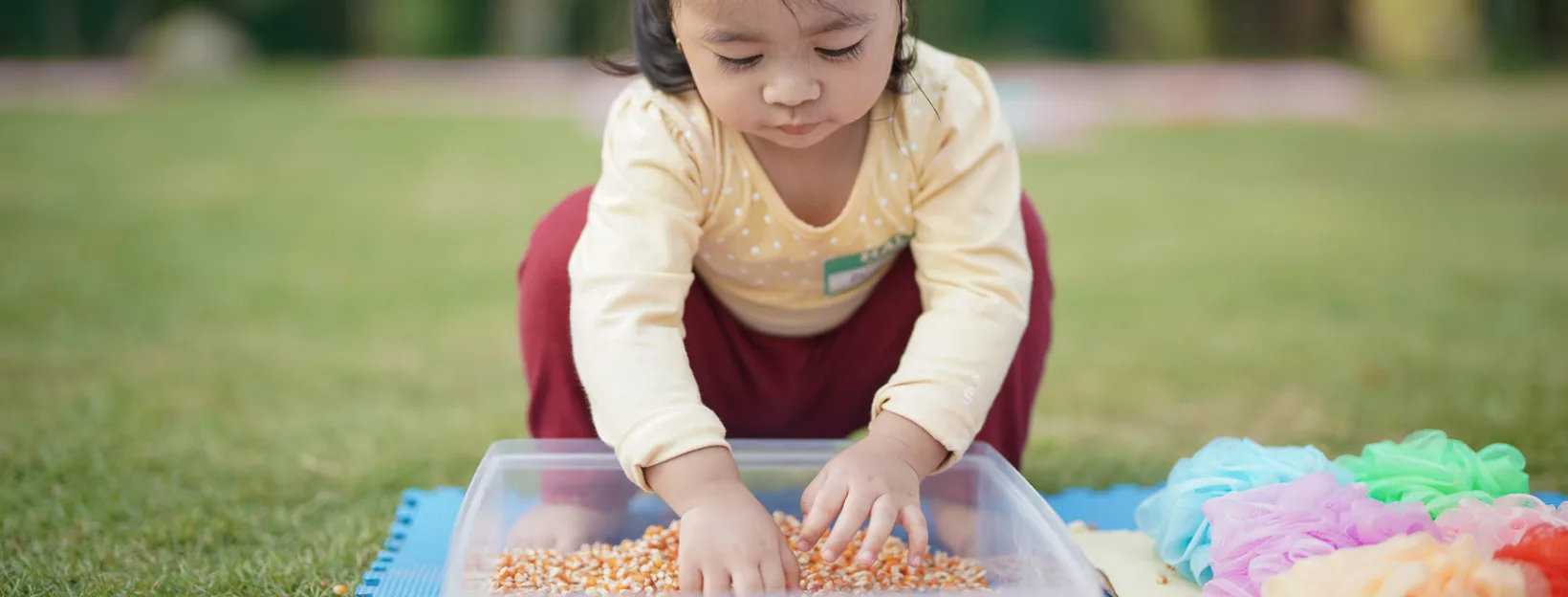
1. Learn your child's sensory profile. Observe: what inputs overwhelm them? What inputs do they seek? Where on the spectrum are they across the different senses? Books like The Out-of-Sync Child by Carol Kranowitz are practical introductions for parents.
2. Accommodate reasonably, especially for clothing and environment. Tagless clothes, seamless socks, softened fabrics, quieter environments when possible, noise-reducing headphones for sensory-overwhelming places. These aren't indulgences — they're functional adjustments that let the child's nervous system operate better.
3. Build regulation skills. Teach your child to notice their sensory state ("I feel shaky," "too loud") and to access coping tools (deep breaths, a squeeze hug, noise-cancelling headphones, a quiet corner). Agency over the regulation is more sustainable than having an adult always predict and prevent.
4. Build heavy work into daily life. Carry laundry baskets. Push the grocery cart. Help move furniture. Climb on playgrounds. The proprioceptive input is regulating across profiles.
5. For significant cases, get an OT evaluation. A pediatric occupational therapist trained in sensory integration can identify specific patterns, design interventions, and work with families. For persistent, prominent sensory difficulties, this is high-value care.
6. Connect the sensory profile to school. If your child has sensory issues affecting school function, request sensory-informed accommodations: quiet work space options, wiggle seats or movement breaks, noise-reducing tools, sensory-safe clothing options. Many schools will implement these.
7. Don't force through every sensitivity. The "just make him put on the shirt" approach often backfires — creates lasting negative associations with clothing, with the parent, with the sensory experience. Gradual exposure, paired with accommodation for the most distressing items, produces better outcomes.
8. Respect preferences that are sensory, not behavioral. If your child is insistent about eating food of one texture, being in one room, wearing one kind of clothing — these are often sensory patterns, not defiance. Respecting the pattern while gently expanding the tolerance over time is the work.
9. Watch for overload. Sensory overload is cumulative. A kid can be fine until they're not — grocery store + loud music + bright lights + hungry + tired → meltdown. Managing the cumulative load (leaving before overwhelm, building in sensory rest time) prevents the cliff.
10. For sensory seekers, provide intense input safely. Trampolines, climbing walls, crash mats, swings, deep pressure vests, resistance activities. Channel the seeking into safe, high-intensity activities. A sensory seeker without outlet will find outlet; better to provide structured options.
The Bottom Line
Sensory processing is a real, neurologically-based dimension of how children experience the world. For kids with significant sensory differences, the gap between how they're experiencing sensory input and how their adults assume they're experiencing it is enormous — and that gap is the source of most of the conflict.
The reframe — sensory, not behavioral — changes everything about how to respond. Accommodations become functional support, not indulgence. Interventions become targeted to the specific processing pattern. And the child stops being "difficult" and starts being "differently wired in a way we now understand and can support."
At Avaneuro, the Sensory Processing module walks through each sensory channel, profile identification, home strategies, and criteria for occupational therapy referral. Because sensory differences, once recognized, become workable — and often many of the "problem behaviors" resolve when the underlying sensory reality is respected.
Your child's nervous system is doing its best with the information it's getting. Sometimes the information is more intense, or less organized, or less reliable than it is for other kids. That's not a character flaw. That's the hardware. The software runs better when you match the accommodations to the hardware.
Go deeper: This article builds on Avaneuro's Sensory Processing & Integration module — the full protocols, tools, and cited evidence base.
Related reading
- How Movement Builds Your Child's Brain (Not Just Their Body)
- Why 3 Hours Outside a Day Is Not Optional for a Child's Brain
- Posture and Cognition: Why Slouching Costs Your Child More Than You Think
References
- Ahn, R.R., et al. (2004). Prevalence of Parents' Perceptions of Sensory Processing Disorders Among Kindergarten Children. American Journal of Occupational Therapy, 58(3), 287–293. https://pubmed.ncbi.nlm.nih.gov/15202626/
- Schoen, S.A., et al. (2019). A Systematic Review of Ayres Sensory Integration Intervention for Children with Autism. Autism Research, 12(1), 6–19. https://pubmed.ncbi.nlm.nih.gov/30548827/