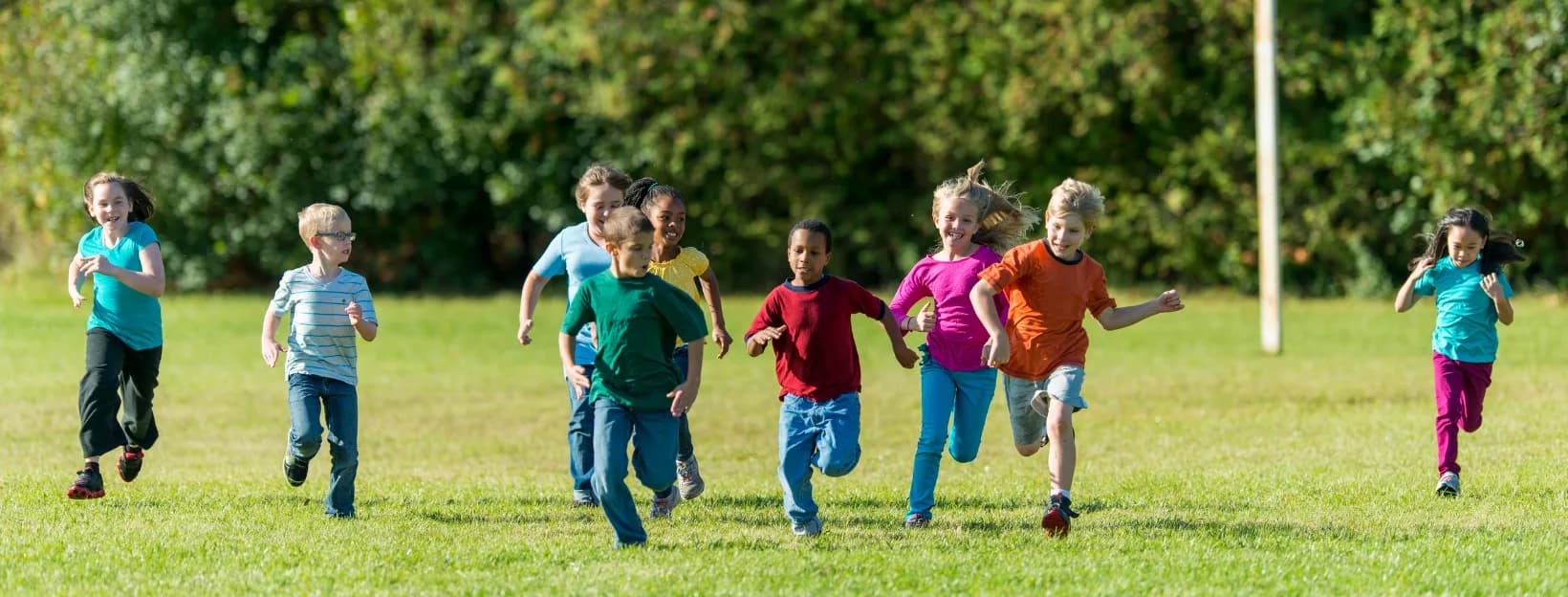
The Best Research-Backed Ways to Use Movement and Nature to Build Your Child's Brain
Your child's brain was built to be calibrated by a moving body in a natural environment. Here are the highest-leverage ways to give it what it's waiting for — each one grounded in real research, not folklore.
A generation ago, none of this needed a name. Kids went outside, ran around on uneven ground, climbed things, came home dirty, and their nervous systems got exactly the inputs they were built to expect. That default is gone. Most American elementary schoolers now spend the majority of their waking hours seated, and the cost lands somewhere parents rarely look — in the developing brain itself.
Here's the reframe that changes everything: movement and outdoor time aren't recreation layered on top of "real" development. They are the development. The brain evolved to guide a moving body, and it gets calibrated by movement, light, terrain, and touch. Take those away and the systems that depend on them don't develop on schedule — they show up later as the "fidgety" kid, the "can't focus" kid, the kid melting down in the grocery store.
You don't need a gym membership or a special program for any of this. You need to know which inputs matter most and how to deliver them. So here are the best research-backed ways to use movement and nature to build your child's brain — ranked roughly by how much leverage each one gives you for the effort it takes.
1. Get them moving every day — movement literally grows brain tissue
Daily moderate-to-vigorous physical activity isn't about fitness. It's the single most direct lever you have on the developing brain, because the machinery exercise switches on is the same machinery the brain uses to grow.
Exercise — particularly moderate-to-vigorous aerobic activity — increases brain-derived neurotrophic factor, a protein sometimes called "Miracle-Gro for the brain," supporting neuron survival, synapse formation, and neuroplasticity (Hillman et al., 2008).
Aim for at least an hour of real movement a day, and treat it as non-negotiable as brushing teeth. The full mechanism — BDNF, neurotransmitters, hippocampal growth, executive function — is in the deep dive: How Movement Builds Your Child's Brain (Not Just Their Body).
2. Put them outside for two to three hours a day
Outdoor time is the highest-density input you can give a child — it stacks circadian calibration, vitamin D, sensory variety, immune training, and stress reduction into a single thing your kid is doing anyway. None of it substitutes indoors.
One of the best-documented payoffs is attention itself: time in natural environments has been shown to restore attention capacity in a way that indoor environments don't (Berman et al., 2008).
So the after-school order matters. Outside first, then homework — the outdoor time improves the homework that follows. Why two to three hours isn't an exaggeration, and how city families pull it off: Why 3 Hours Outside a Day Is Not Optional for a Child's Brain.
3. Trade structured screens for time in actual nature
Not all "outside" is equal, and not all calm is equal. A backyard with trees, a creek, a patch of woods — actual nature does something to the nervous system that a paved playground or a plant on the windowsill can't fake.
The body shows it in the chemistry: forest bathing research has documented measurable cardiovascular and cortisol effects (Park et al., 2010).
When your kid comes home wound tight, the intervention isn't a quiet room — it's trees. Build a rotating "portfolio" of green spaces so the sensory and microbial variety keeps changing. More on why nature specifically outperforms built environments: Why 3 Hours Outside a Day Is Not Optional for a Child's Brain.
4. Feed the two hidden senses — climbing, swinging, heavy lifting
Most of us learned five senses. There are at least seven, and the two internal ones — proprioception and the vestibular sense — are the ones modern childhood starves. They're also the ones that drive regulation, focus, and the ability to sit still when it's time.
These senses are built through specific inputs: proprioception develops through movement, climbing, heavy lifting, pushing, pulling; the vestibular sense develops through swinging, rolling, spinning, jumping, changing head positions (per Avaneuro's Sensory Processing module).
So the regulating move for a dysregulated kid is counterintuitive: more input, not less. Monkey bars, carrying groceries, crashing into cushions, rolling down a hill. Why a child melts down over a sock seam — and why "heavy work" calms almost every nervous system: Sensory Processing: Why Some Children Melt Down Over a Sock Seam.
5. Build daily "heavy work" into ordinary life
You don't need a sensory gym. The most universally regulating input — proprioception — is delivered by chores, play, and movement you can fold into a normal afternoon, and it helps over-responsive, under-responsive, and seeker kids alike.
This is why it's worth knowing how common these differences are: approximately 5–16% of school-age children show significant sensory processing differences, depending on the population studied and the threshold used (Ahn et al., 2004).
Carry the laundry basket. Push the cart. Climb at the park. Squeeze putty. It's free, it's regulating, and it works across profiles. The full home protocol — and when to seek an OT evaluation: Sensory Processing: Why Some Children Melt Down Over a Sock Seam.
6. Protect daily sun exposure on bare skin
Sunlight is two interventions in one ten-minute window: it anchors the circadian clock and it's the body's most efficient vitamin D source — and vitamin D turns out to be far more than a bone nutrient.
It behaves like a hormone: vitamin D is a steroid hormone that regulates gene expression in hundreds of tissues, and low status has been associated with depression, seasonal affective disorder, increased respiratory infection rates, autoimmune tendency, and in children specifically, concerns about bone development, immune function, and mood regulation (Holick, 2007).
Short daily doses of bare-skin sun — longer for darker-skinned kids, who need more UVB for the same synthesis — then sunscreen for the long exposures. The dosing-by-age-and-skin-type protocol, plus why "sunny climate" doesn't mean "adequate": Sunlight, Vitamin D, and Your Child's Mood: More Than a Vitamin Story.
7. Break up the slump — vary their posture and positions
The kid hunched over a tablet for hours isn't just temporarily uncomfortable. They're training a musculoskeletal pattern, a breathing pattern, and a default that will cost effort to undo later. And posture quietly reaches into mood and attention.
The link runs both directions: posture-mood research has shown that upright posture acutely improves mood and reduces feelings of fatigue and depression compared to slumped posture (Nair et al., 2015).
The fix isn't nagging "sit up straight." It's variety — standing, floor, walking, movement breaks every 30 minutes, screens at eye level. Why slouching compounds silently, and the age-appropriate strengthening that counters it: Posture and Cognition: Why Slouching Costs Your Child More Than You Think.
8. Default to unstructured, varied, outdoor play
If you do only one thing, do this. Unstructured play on interesting terrain — climbing, balancing, running over uneven ground — delivers the vestibular and proprioceptive inputs that organized indoor sports simply can't replicate, and it folds movement, nature, sensory development, and posture variety into one activity.
It even protects the eyes: more outdoor time means less myopia, an inverse relationship found independent of how much close work children do (Sherwin et al., 2012).
So let them out, let them climb, let them get a little dirty and take a little appropriate risk. Bruises happen. Developmental benefits accrue. The case for unstructured play over structured programming: Why 3 Hours Outside a Day Is Not Optional for a Child's Brain.
Where to start
You don't have to do all eight at once. Pick the after-school hour and protect it: outside, moving, on varied ground, before screens. That single habit quietly delivers most of this list.
When you're ready to make it systematic — by age, by stage, with the specific protocols — the school-age movement module lays out exactly how to build it into your week. The brain your child is building depends on it.
References
- Hillman, C.H., et al. (2008). Be Smart, Exercise Your Heart: Exercise Effects on Brain and Cognition. Nature Reviews Neuroscience, 9(1), 58–65. https://pubmed.ncbi.nlm.nih.gov/18094706/
- Berman, M.G., et al. (2008). The Cognitive Benefits of Interacting with Nature. Psychological Science, 19(12), 1207–1212. https://pubmed.ncbi.nlm.nih.gov/19121124/
- Park, B.J., et al. (2010). The Physiological Effects of Shinrin-Yoku (Taking in the Forest Atmosphere or Forest Bathing). Environmental Health and Preventive Medicine, 15(1), 18–26. https://pubmed.ncbi.nlm.nih.gov/19568835/
- Ahn, R.R., et al. (2004). Prevalence of Parents' Perceptions of Sensory Processing Disorders Among Kindergarten Children. American Journal of Occupational Therapy, 58(3), 287–293. https://pubmed.ncbi.nlm.nih.gov/15202626/
- Holick, M.F. (2007). Vitamin D Deficiency. New England Journal of Medicine, 357(3), 266–281. https://pubmed.ncbi.nlm.nih.gov/17634462/
- Nair, S., et al. (2015). Do Slumped and Upright Postures Affect Stress Responses? A Randomized Trial. Health Psychology, 34(6), 632–641. https://pubmed.ncbi.nlm.nih.gov/25222091/
- Sherwin, J.C., et al. (2012). The Association Between Time Spent Outdoors and Myopia in Children and Adolescents: A Systematic Review and Meta-Analysis. Ophthalmology, 119(10), 2141–2151. https://pubmed.ncbi.nlm.nih.gov/22809757/